Slit Coil Racks
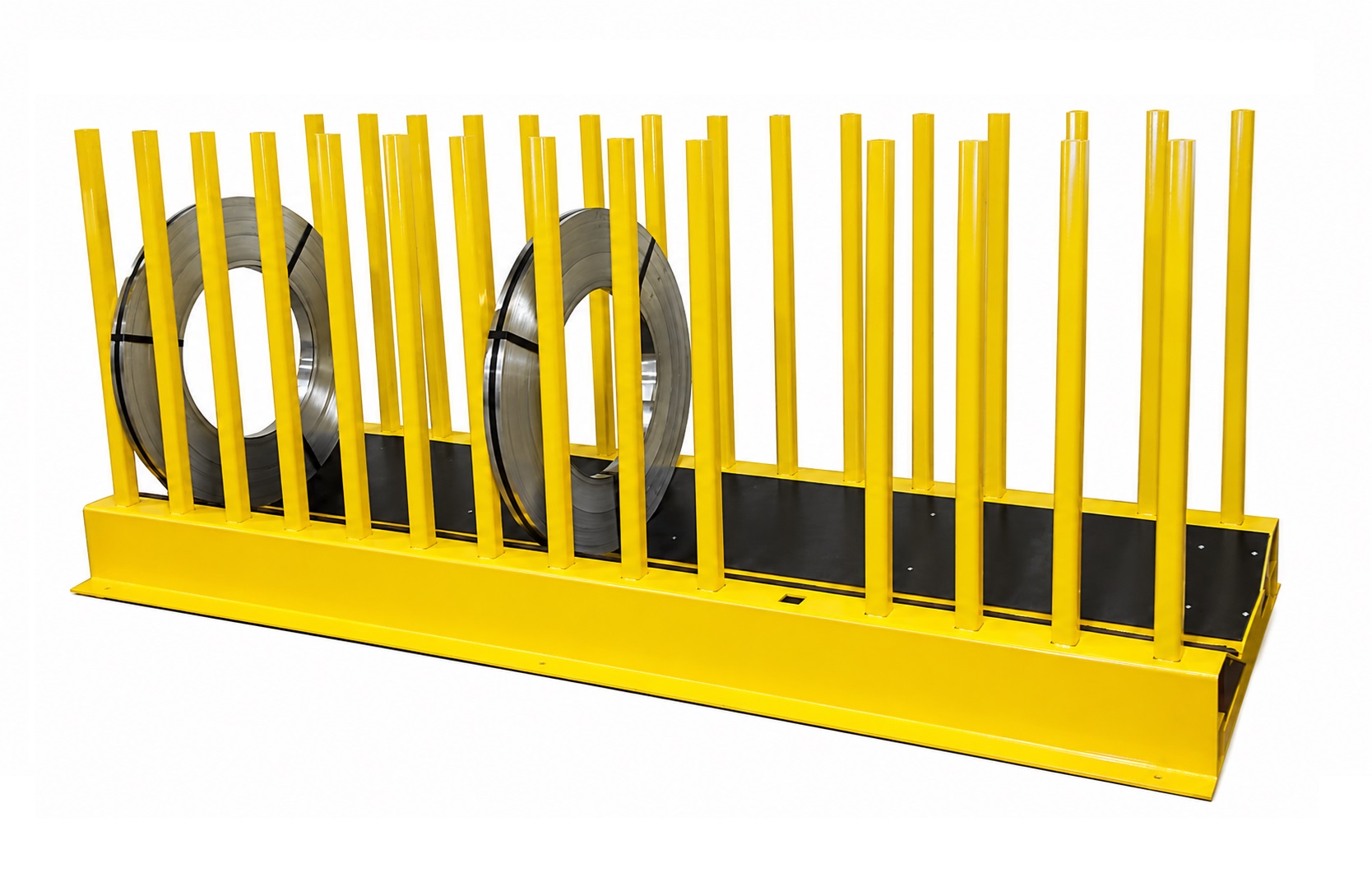
Slit coil racks are heavy-duty steel storage systems designed to organize, support, store, and, in some configurations, transport narrow steel coils that are difficult to handle with conventional pallet rack or master coil racks. Slit coils are typically tall, narrow, and very heavy, so the rack needs to control the coil while providing the access required for loading and retrieval. Depending on the application, slit coil racks can be stationary, mobile, portable, stackable, or built from structural I-beams for extremely heavy loads. Adjustable posts, fork pockets, fork tunnels, reinforced steel supports, and custom dimensions allow the rack to be designed around coil diameter, width, weight, orientation, and material flow. Slit coils are a storage problem. The right rack turns them into organized inventory.
Heaviest Duty Structural I-Beam Slit Coil Racking
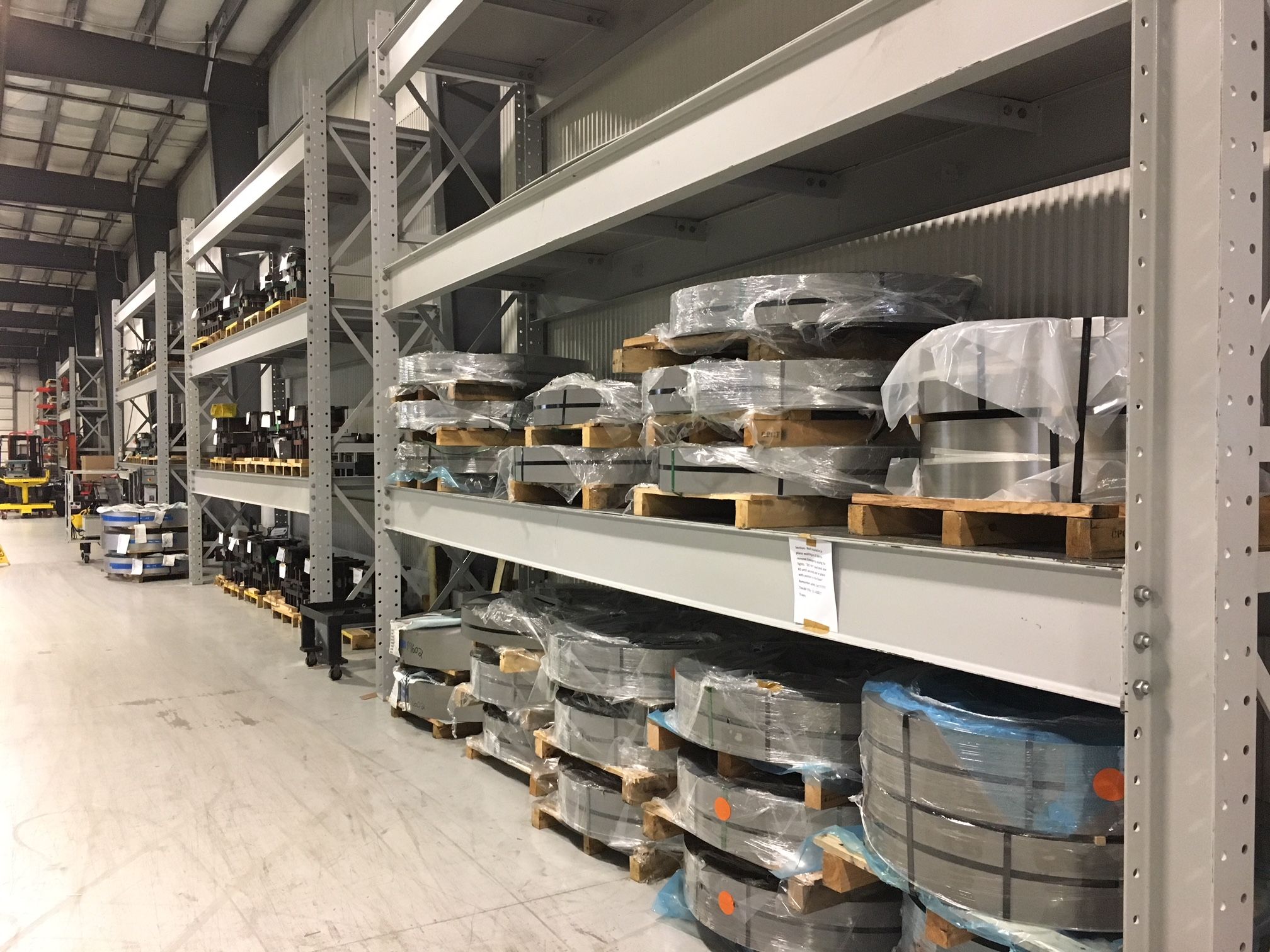
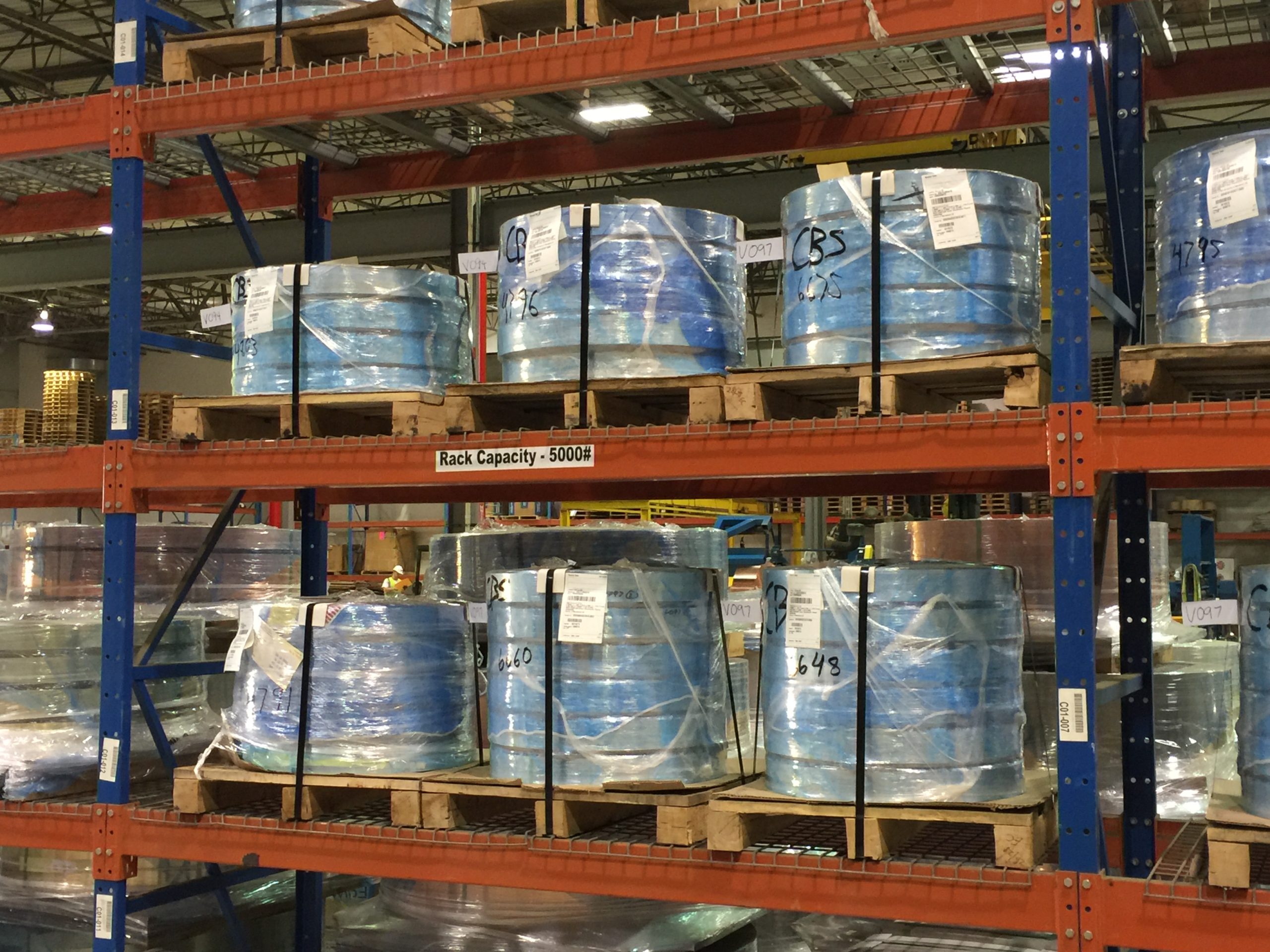
Storing heavy slit coils in conventional pallet rack can get complicated quickly. A slit coil may weigh thousands of pounds while concentrating that weight over a relatively small area. If the coil is placed between the front and rear load beams, you have a point load that ordinary pallet rack decking may not be designed to support.
Showing all 6 resultsSorted by latest
Heaviest Duty Structural I-Beam Slit Coil Racking
Portable Slit Coil Racks Transport Slit Coils While In The Rack

Mobile Slit Coil Racks Can Be Transported Without Slit Coils in Rack
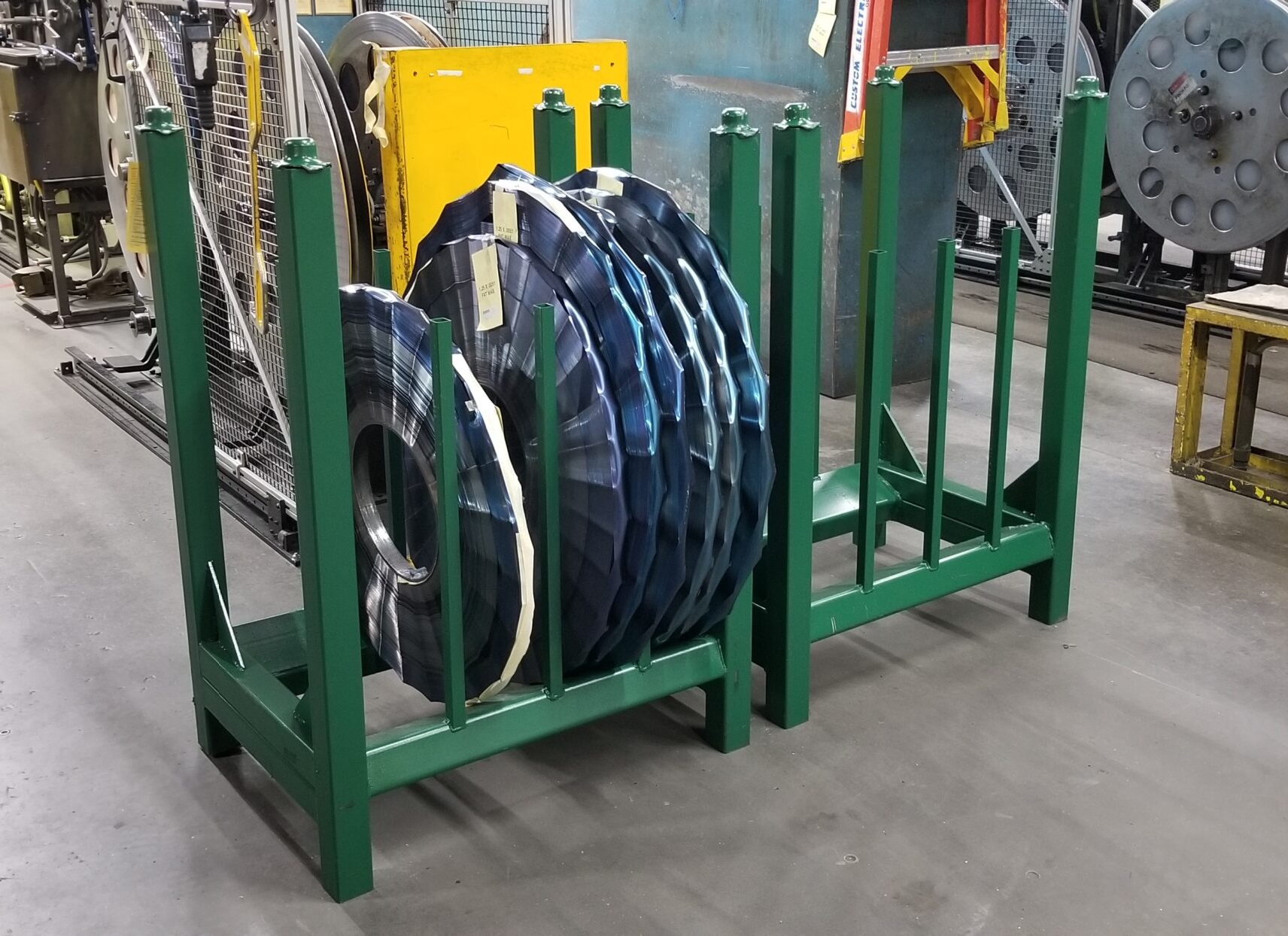
Slit Coil Stacking Systems | Stackable Slit Coil Storage & Transport Racks
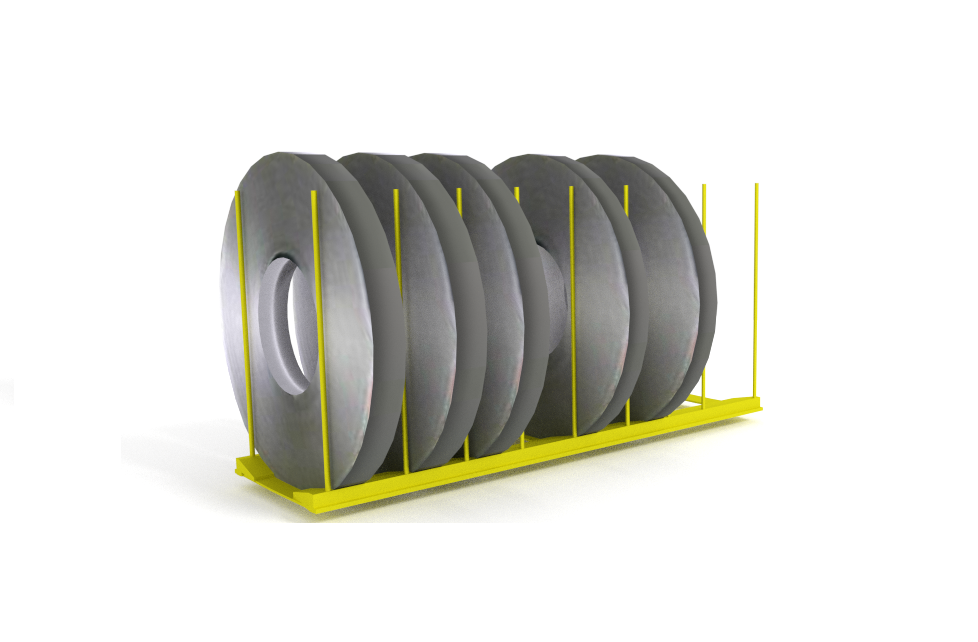
Stationary Slit Coil Floor Storage Racks
Slit Coil Rack for Sale
For these applications, we offer structural I-beam slit coil racking built with heavy structural steel upright frames and horizontal load beams. Bolted beam ties, reinforced shelf supports, and thick steel top plates can be incorporated to create shelves designed around concentrated loads. Depending on the engineered configuration, these systems can be designed for point loads ranging from approximately 15,000 to 35,000 pounds.
This also gives you flexibility when coil diameters and weights vary. Instead of trying to make every coil land directly over a conventional front and rear pallet rack beam, the shelf can be designed to support the load where the coil actually sits.
And that’s the point. When you’re putting 15,000, 20,000, 25,000 pounds or more on a shelf, don’t try to make ordinary pallet rack do a job it wasn’t designed to do.
Portable Slit Coil Racks Transport Slit Coils While In The Rack
Here’s where terminology matters. Portable and mobile slit coil racks aren’t the same thing.
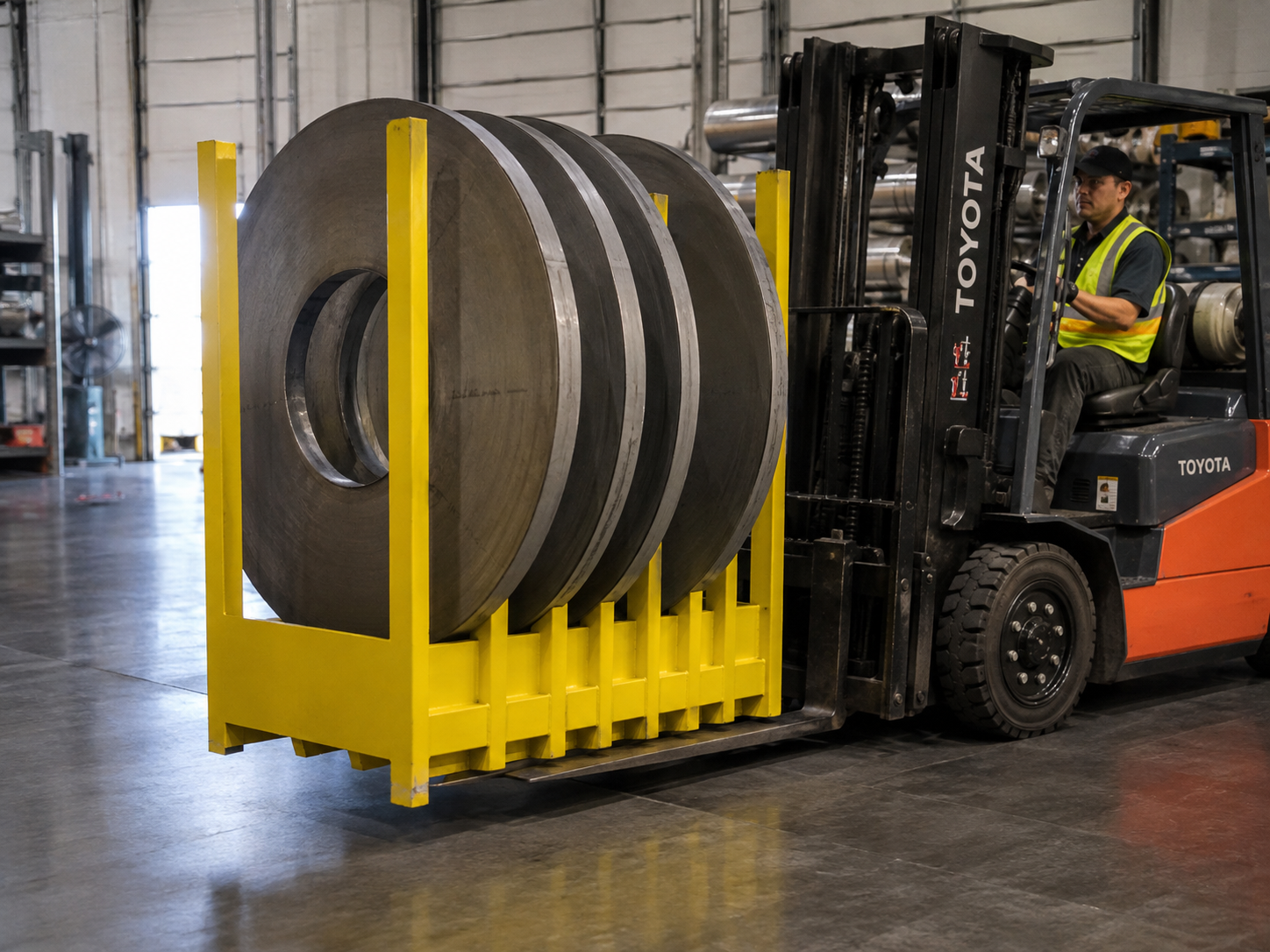
Portable slit coil racks are designed so the rack can be picked up and transported while the slit coils remain in the rack. Rigid welded end posts provide the structure, while fork tunnels in the base provide defined engagement for the forklift. Instead of unloading the coils, moving an empty rack, and reloading everything, the rack and its contents can move together when the rack has been designed and rated for that operation.
Portable slit coil racks are available for different coil ranges, including configurations for approximately 24″ to 50″ diameter coils and larger designs for approximately 34″ to 72″ diameter coils. Coils are stored upright and eye to the aisle, making individual coils easier to identify, load, and retrieve.
For manufacturing operations, that portability can be a big advantage. Load the rack in the storage area, move the entire rack to production, and put it where the material is needed. The rack isn’t just storage anymore. It becomes part of the material handling process.
Mobile Slit Coil Racks Can Be Transported Without Slit Coils in Rack
A mobile slit coil rack can also be relocated with a forklift, but there’s one important difference: the rack must be empty when it is moved.
Fork pockets in the base allow an empty mobile rack to be lifted and relocated as production layouts or storage requirements change. Once positioned, slit coils are loaded vertically into the rack. Adjustable posts allow the openings to be changed for coils of different thicknesses, while the open configuration keeps inventory visible and accessible.
Mobile racks make sense when you want flexibility in your warehouse layout but don’t need to transport coils inside the rack. Need the rack near one production line this month and somewhere else next month? Move it. That’s a lot easier than relocating a floor-anchored storage system.
Slit Coil Stacking Systems | Stackable Slit Coil Storage & Transport Racks
Stackable slit coil racks combine portable storage with vertical stacking. They’re designed for operations where floor space is limited and fixed rack isn’t necessarily the best answer. Individual racks hold and organize slit coils, and compatible units can be stacked to use the space above the floor rather than spreading inventory across the building.
These systems can also simplify material flow. Portable stackable racks can be picked up with a forklift and moved with their slit coils when specifically designed for loaded transport. That means material can move from storage toward production without unloading and reloading every individual coil.
If your floor is covered with palletized slit coils, look up. You may already have the storage space you need. You’re just not using it.
Stacking height and loaded transport capability depend on the specific rack design, coil dimensions and weight, forklift requirements, floor conditions, and engineered capacity. With steel coils, “it fits” and “it’s designed for it” are two very different things.
Stationary Slit Coil Floor Storage Racks
Sometimes simpler is better. Stationary slit coil floor racks provide dedicated ground-level locations for coils without adding portability or elevated storage. The rack is anchored to the floor, and adjustable vertical posts create individual storage positions for different coil thicknesses.
This configuration works particularly well when slit coils need to remain upright and eye to the aisle. Because tall, narrow slit coils can be unstable, keeping them at floor level avoids trying to stack upright coils several rack levels high. The rack keeps the coils separated, organized, and accessible while giving each coil a defined storage location.
Stationary slit coil racks can also make inventory easier to manage. Instead of coils leaning together or occupying random floor locations, each coil has its own position. Sometimes the best storage system isn’t the one that moves or stacks. It’s the one that keeps everything exactly where it belongs.
Slit coil orientation is a major part of the rack design. Eye-to-the-aisle means the coil is standing upright with its center opening facing the aisle. This provides direct access to individual coils, but because slit coils can be tall and narrow, upright storage generally requires a rack specifically designed to support and separate them.
Eye-to-the-sky means the slit coil is laid flat with its center opening facing upward. Coils can be placed on pallets, runners, or other engineered supports and stored in a rack designed for the resulting load.
For palletized eye-to-the-sky storage, pay close attention to how the pallet or support interfaces with the rack beams. Heavy slit coils need proper support, and concentrated loads between the front and rear beams can create loading conditions that conventional pallet rack or decking wasn’t designed to handle. Coil dimensions, weight, pallet dimensions, beam spacing, decking, and rack capacity all need to work together.
Slit Coil Racks FAQ
Which type of slit coil rack do I need?
Start with how you want to store and move the coils. If the rack will remain in one location, a stationary floor rack may be the simplest solution. If you want to relocate the empty rack, consider a mobile design. If coils need to move while remaining in the rack, you’ll need a portable rack specifically engineered for loaded transport. Stackable racks can increase storage density, while structural I-beam systems are available for extremely heavy concentrated loads.
Then get specific. You’ll need coil diameter, width or thickness, maximum weight, quantity, storage orientation, handling equipment, and available floor and vertical space before selecting the rack.
Can slit coils be stored several levels high?
It depends on the orientation and storage system. Tall, narrow slit coils stored upright and eye to the aisle require careful control and aren’t simply placed in conventional master-coil cradles several levels high. Eye-to-the-sky coils may be stored at elevated levels when the pallets, rack, beams, decking, floor, and overall system are specifically designed for the loads. Stackable slit coil racks provide another option when the units are engineered for stacking.
Can I install slit coil racks myself?
That depends on the rack. Portable and mobile racks may require relatively little field installation, while stationary racks need to be positioned and anchored according to the system design. Structural I-beam slit coil racking is a different animal. These systems handle very heavy loads and should be installed according to the engineered drawings and manufacturer’s requirements. Floor conditions, anchors, rack configuration, clearances, and handling equipment all need to be considered.




