Case Flow Racks
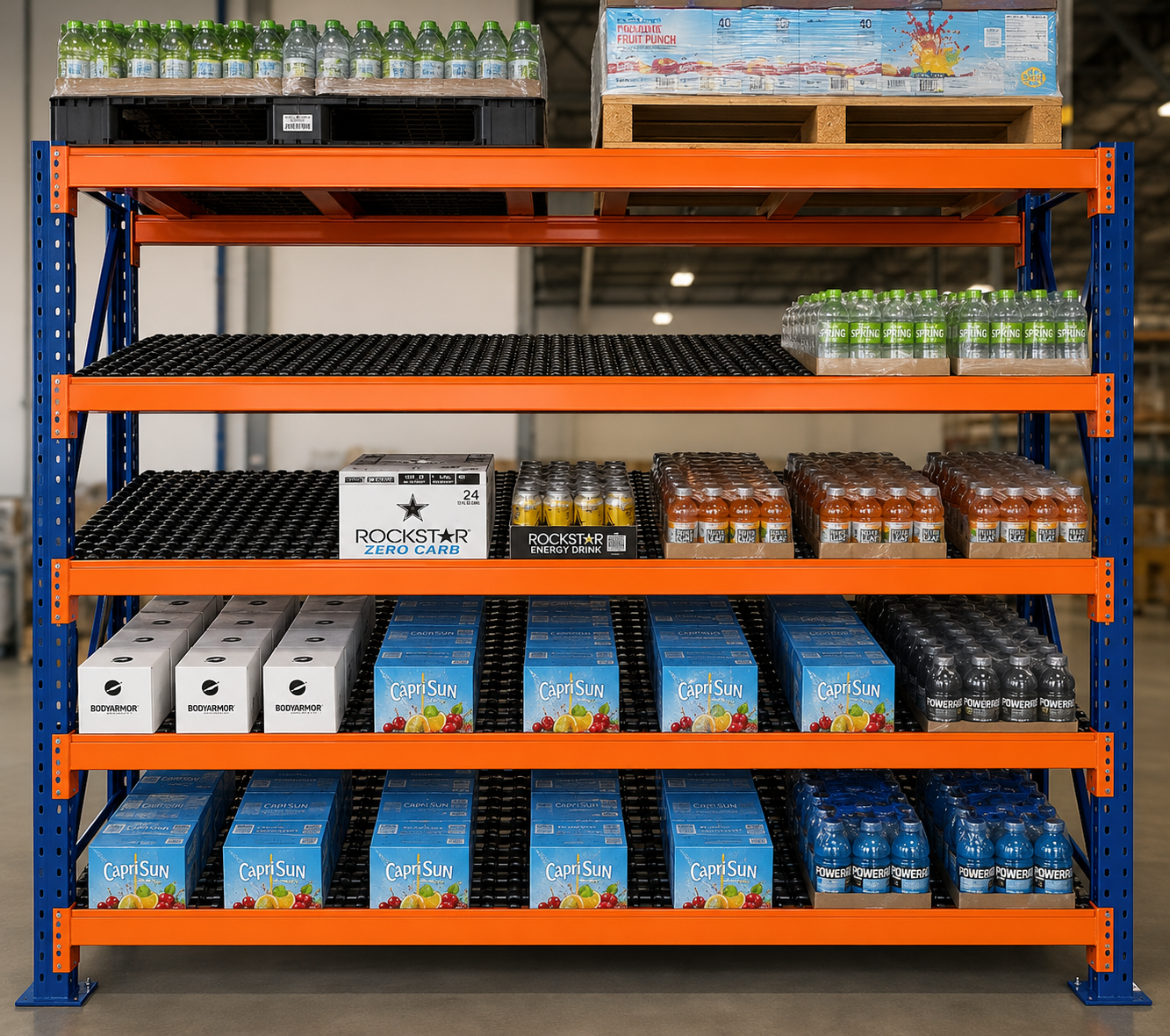
Case flow racks are gravity-fed storage and picking systems designed to move boxes, cartons, totes, and heavier case goods from the loading side of the rack to the picking face. Sloped wheel beds or roller tracks use gravity to keep inventory moving forward, improving picking speed while supporting First-In, First-Out (FIFO) inventory rotation. Case flow can be integrated into pallet rack, installed as a dedicated picking system, and designed with plastic wheels, steel skate wheels, or heavy-duty rollers depending on the product. The big advantage is simple: instead of making employees walk, reach, and search for cases, the cases come to them.
SpanTrack 100 Series Heavy-Duty Steel Skate Wheel Carton Flow Rack System
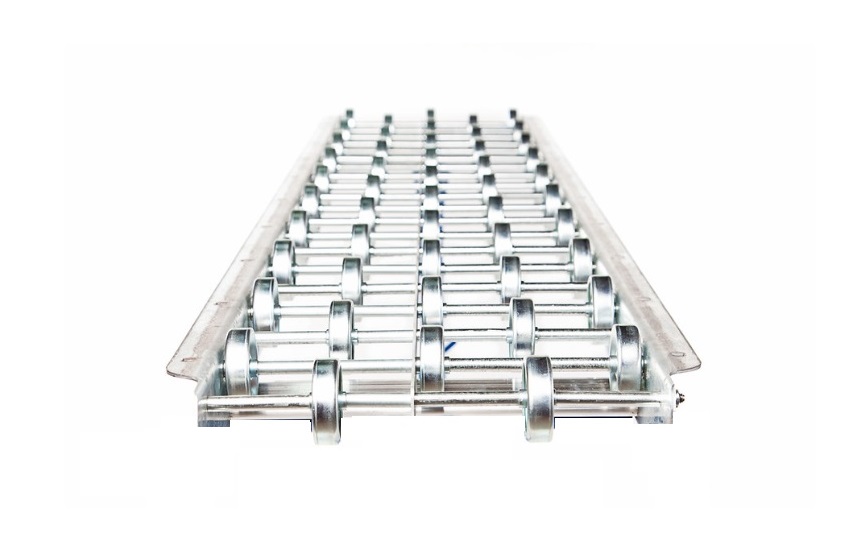
The SpanTrack 100 Series is built for operations where ordinary carton flow isn’t heavy-duty enough. Instead of lightweight plastic wheels, it uses staggered steel skate wheels with precision bearings to flow heavier bins, boxes, cartons, and case goods. The system is rated for loads up to 100 pounds per linear foot in unsupported spans up to 96″, making it well suited for manufacturing plants, distribution centers, fulfillment operations, automotive parts, tools, and other heavier products.
Showing all 5 resultsSorted by latest
SpanTrack 100 Series Heavy-Duty Steel Skate Wheel Carton Flow Rack System
Dyna-Flo HD Carton Flow | Staggered Plastic Wheel Carton Flow Beds
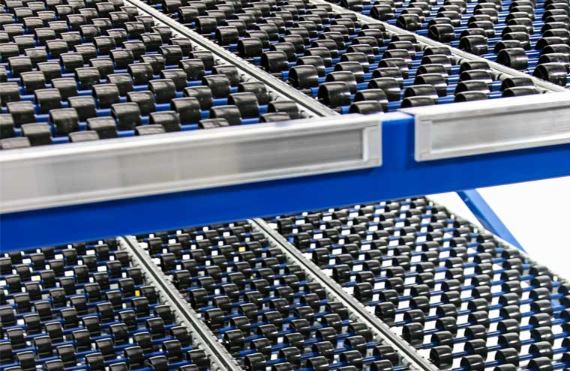
Dyna-Flo Staggered Wheel Carton Flow Specification Sheet
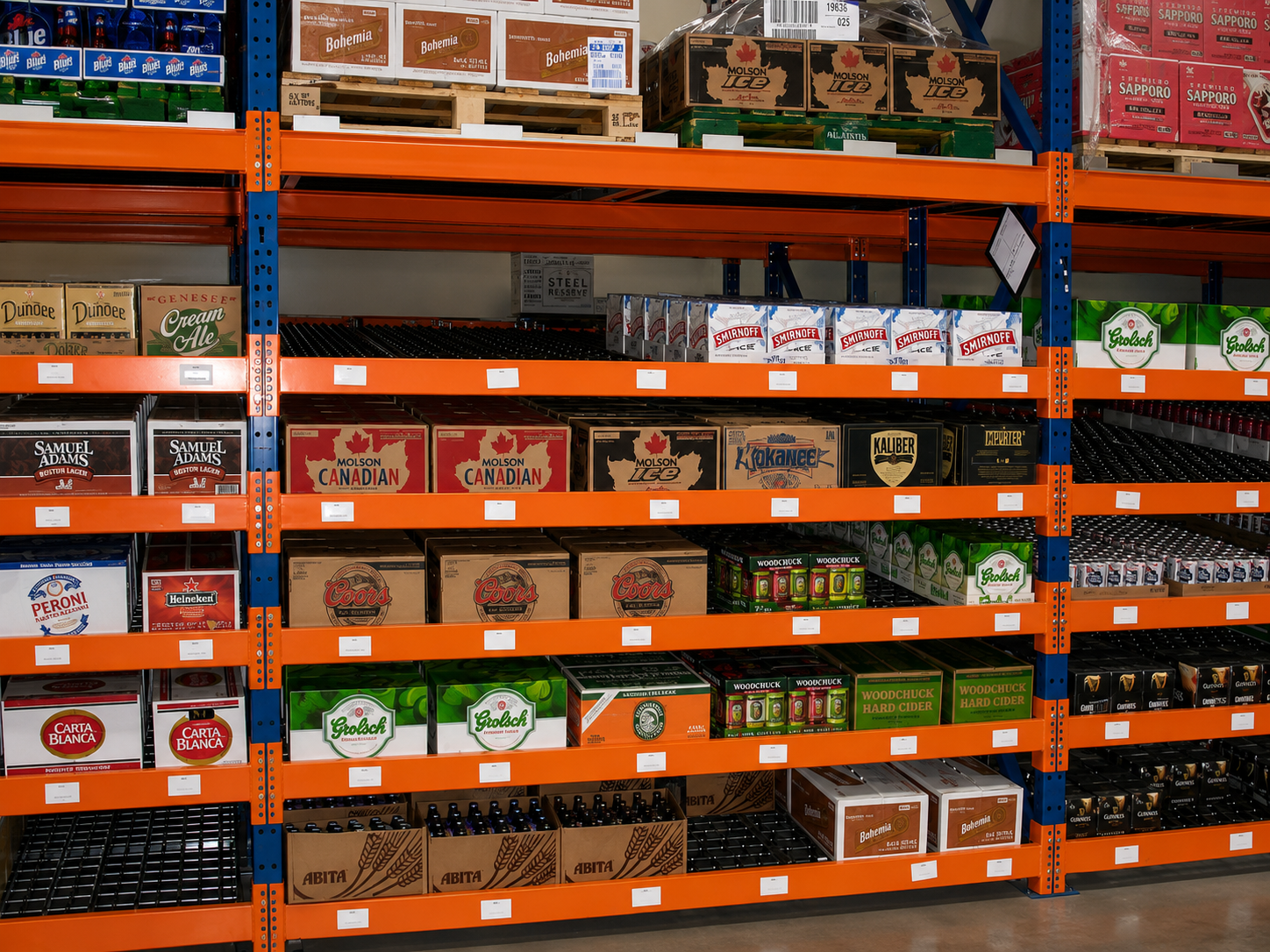
Case Flow: Beer, Liquor & Wine Carton Flow Racks
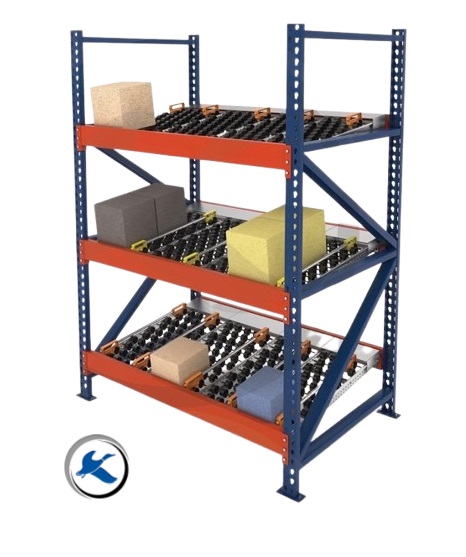
Heavy Duty Gravity Flow Racks
The steel wheel tracks integrate directly into pallet rack and can be used in 36″, 42″, and 48″ single-deep systems or 96″ double-deep applications. They can work with common beam styles including step beams, box beams, and structural C-channel beams. Compared with the SpanTrack 99 Series at 50 pounds per linear foot, the 100 Series doubles the capacity. If you’re flowing heavy products and employees are going to throw cases onto the rack all day, this is the kind of system you want underneath them.
Dyna-Flo HD Carton Flow | Staggered Plastic Wheel Carton Flow Beds
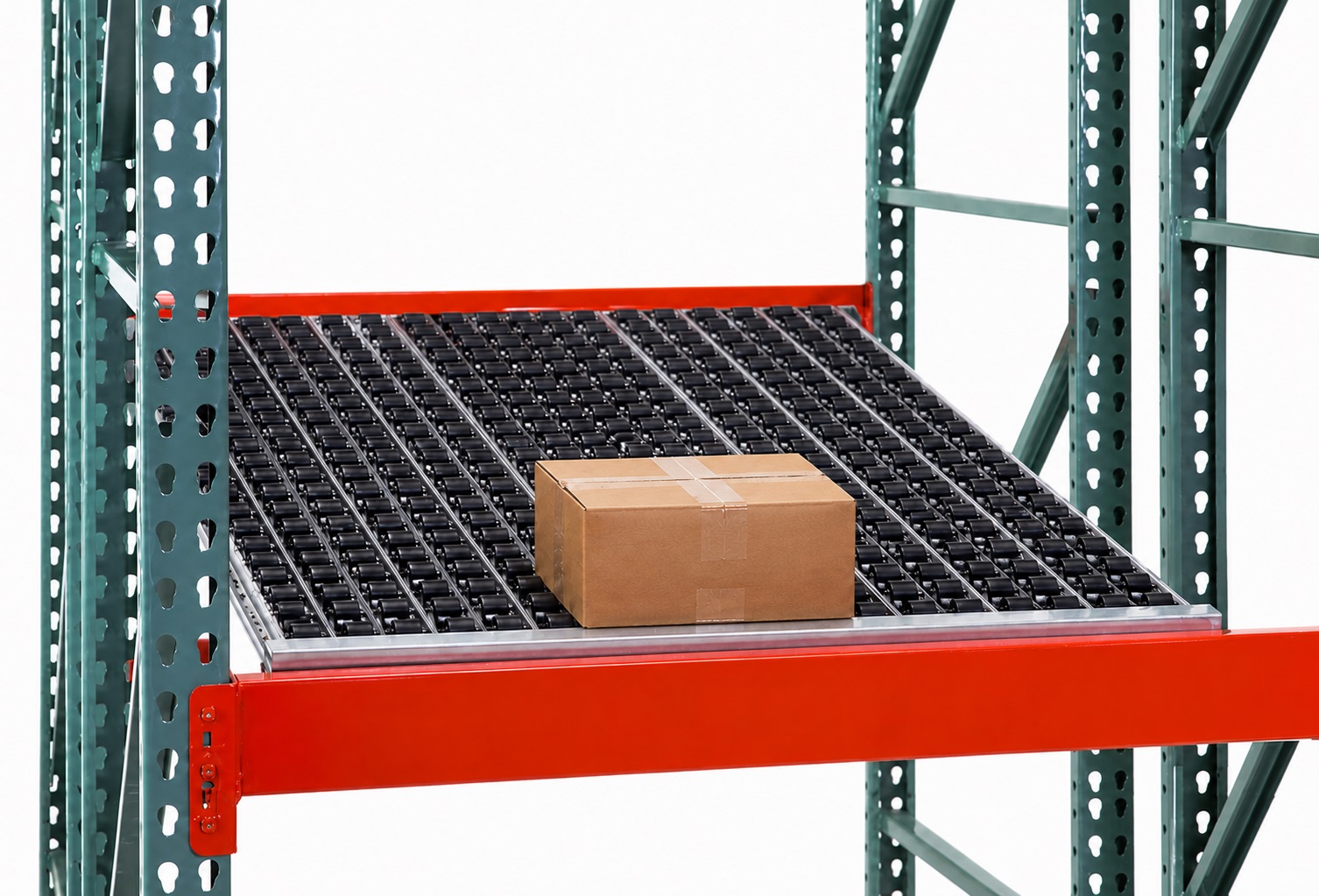
Let’s get one thing out of the way. Dyna-Flo HD staggered wheel carton flow costs more than basic plastic-wheel systems and can cost more than full-width roller tracks. What you get for the additional money is flexibility, durability, and consistent flow. You aren’t locked into fixed lanes. Different size cartons can be positioned anywhere across the flow bed as long as they have adequate wheel support.
Dyna-Flo HD uses heavy-duty 1.9″ polypropylene wheels staggered across steel flow beds, typically spaced approximately 2″ to 3″ on center depending on the carton. Smaller boxes may require tighter spacing. The beds hang between the front and rear pallet rack beams, with the rear beam typically raised to create the slope needed for reliable flow.
TIP FROM THE PRO: Standard staggered wheel beds don’t necessarily need a separate front stop because the front pallet rack beam can act as the stop. Additional stops can be added when required. Full-length lane dividers or less expensive lane flags can also be used when you want to define individual SKU locations without giving up the flexibility of a staggered wheel bed.
Case Flow: Beer, Liquor & Wine Carton Flow Racks
Beer, liquor, and wine distribution involves a lot of case picking, which makes it a natural application for gravity flow. Case flow racks provide dense storage while bringing the next case forward as soon as one is removed. Systems can be loaded from the rear and picked from the front for FIFO inventory rotation or configured for front loading and picking when the operation calls for it.
The system can also be designed around the building. A 48″ deep case flow rack may work well along perimeter walls, while 96″ deep systems can provide additional storage density in the middle of a facility. Depending on the case sizes, weights, and SKU mix, flow beds can use staggered poly wheels or full-width rollers. Case flow can also be combined with bottle flow, keg flow, pallet flow, picking carts, or conveyors to create a complete beverage picking operation.
Sometimes standard carton flow simply isn’t heavy enough. Heavy-duty gravity flow racks use stronger steel rollers and heavier construction to handle boxes, totes, parts, and cases that would eventually beat up a lighter-duty system. Pick the front case and the one behind it rolls forward, giving you the same picking and ergonomic advantages as conventional carton flow with considerably more muscle underneath it.
These aren’t the cheapest gravity flow racks on the market, and they’re not supposed to be. Anyone who has spent time around a busy warehouse knows employees don’t gently place every heavy case onto a flow lane. Boxes get dropped. Totes get thrown. That’s real warehouse life. If your products are heavy and your operation runs multiple shifts, buying a flow system designed to take the impact can be a lot less expensive than constantly repairing or replacing one that wasn’t.
Case Flow Rack FAQ
Should I use steel wheels, plastic wheels, or full-width rollers?
Start with the product you’re flowing. Consider case dimensions, weight, bottom construction, SKU variety, and how roughly the system will be used. Staggered plastic wheels provide excellent flexibility for changing carton sizes. Steel skate wheels provide greater capacity for heavier case goods, while full-width rollers provide continuous support and defined lanes. There isn’t one best style for every warehouse.
How much slope does a case flow rack need?
Enough to provide reliable, controlled flow—but not so much that heavy cases come flying toward the picker. Product weight, carton dimensions, bottom condition, rack depth, and roller or wheel type all affect the required pitch. Raising the rear beam is a common way to create the proper slope. For larger projects, testing actual cases before finalizing the entire system is a smart move.
Can case flow be installed in my existing pallet rack?
Often, yes. Many case flow tracks and beds are designed to hang between existing front and rear pallet rack beams. But don’t assume everything fits everything. Beam style, clear opening, rack depth, capacity, track length, required pitch, and product loads should all be checked before ordering. Existing rack should also be inspected to make sure it is suitable for the application.
What maintenance does a case flow system require?
Keep wheels and rollers free of stretch wrap, cardboard, labels, dirt, and other debris. Periodically inspect wheels, rollers, bearings, tracks, hangers, stops, dividers, and rack components for wear or impact damage. Most importantly, watch how your cases flow. If a product that used to roll smoothly suddenly starts hanging up, something changed. Find the cause instead of teaching employees to give every box a shove.




