Specialty Rigid Wire Containers
Specialty rigid wire containers are heavy-duty, non-collapsible steel containers designed for applications that need more strength, durability, or handling capability than a standard wire basket can provide. Depending on the design, they can include heavy-gauge wire mesh, solid or perforated steel sides, reinforced steel floors, drop or swing-out gates, stacking feet, steel runners, fork pockets, and crane lifting lugs. These containers are built to store and transport everything from small components and work-in-process inventory to heavy castings, tools, and bulk materials. Their rigid construction protects the load, wire or perforated sides improve visibility, and stackable designs help you use vertical space instead of valuable floor space. Better yet, specialty containers can be designed around your product and your material handling operation instead of forcing your operation to work around the container.
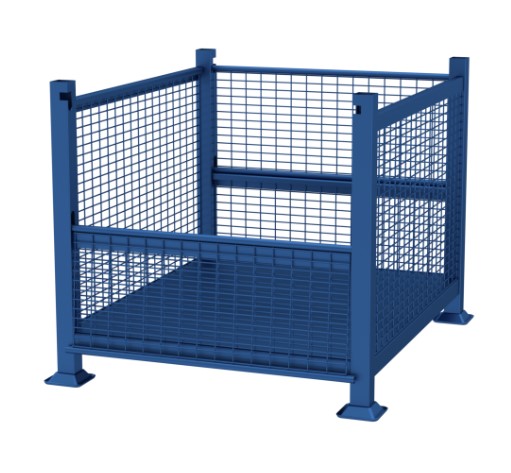
The Davco R2GW-01 is a heavy-duty rigid wire container built for industrial storage and material handling. It measures 40-1/2″ x 34-1/2″ x 32″, provides 18 cubic feet of usable storage, and has a 3,200-lb. capacity. The sides are constructed from heavy 9-gauge 2″ x 1″ wire mesh supported by a strong tubular steel base. A solid sheet metal floor gives heavy and irregularly shaped parts the support they need.
The container can be stacked up to five high, allowing you to store a lot of material in a relatively small footprint. A half drop gate on the 34-1/2″ side provides easier access to the contents without having to reach all the way over the top of the container. The open wire construction also lets employees see what is inside without opening boxes or digging through inventory.
Showing all 5 resultsSorted by latest

Davco R2GW-01 Rigid Wire Containers & Bins
Crane Lift Cage with Swing Out Gate
Rigid Steel Container with Perforated Metal Sides
Heavy Duty Rigid Wire Mesh Containers & Bins
Heavy Duty Rigid Wire Containers
Gray and blue enamel finishes are available to help protect the steel from everyday wear and corrosion. Different colors can also be useful for separating departments, parts, customers, or stages of production. For manufacturing, distribution, retail backrooms, and work-in-process storage, the R2GW-01 gives you a good combination of capacity, visibility, access, and durability.
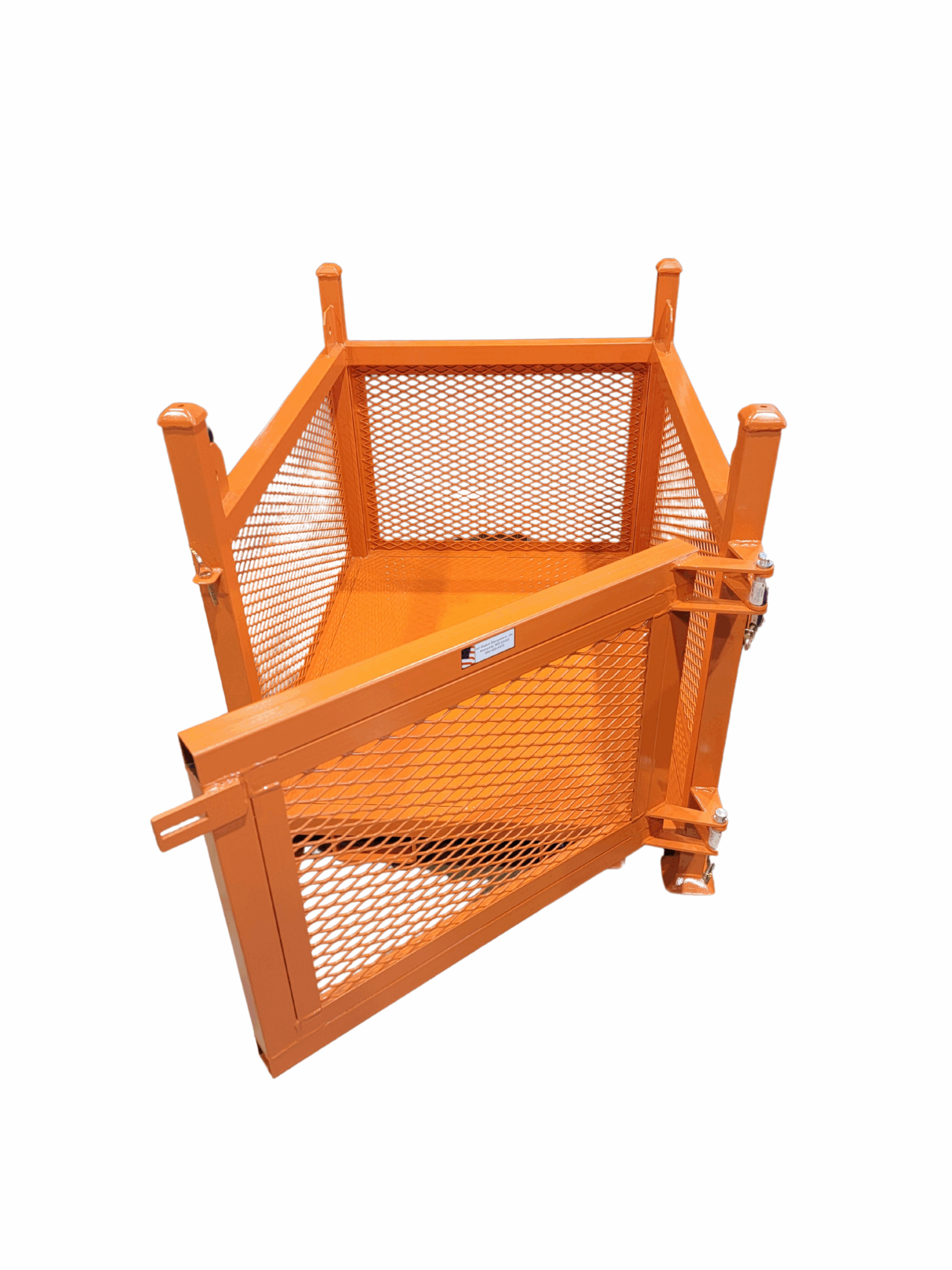
A crane lift cage with swing-out gate is designed for applications where materials need to be stored securely and moved by more than one type of material handling equipment. The heavy-duty steel container has perforated sides that keep the contents contained while still providing visibility and airflow.
The swing-out gate provides a large opening for loading and unloading. Instead of reaching over the top or trying to maneuver awkward materials through a small opening, workers can open the gate and access the container from the side. Once the cage is ready to move, the gate locks securely in place.
What makes this container different is its handling flexibility. Integrated crane lifting lugs allow for overhead lifting, while fork pockets and a reinforced base allow it to be handled by forklift. That can be a big advantage in manufacturing plants, warehouses, fabrication shops, and construction environments where the same container may need to move through several different operations.
Crane lifting is not something you want to add as an afterthought. The cage, lifting points, load, and handling method all need to be designed for the intended application. Tell us how you’re going to move the container before it is built.
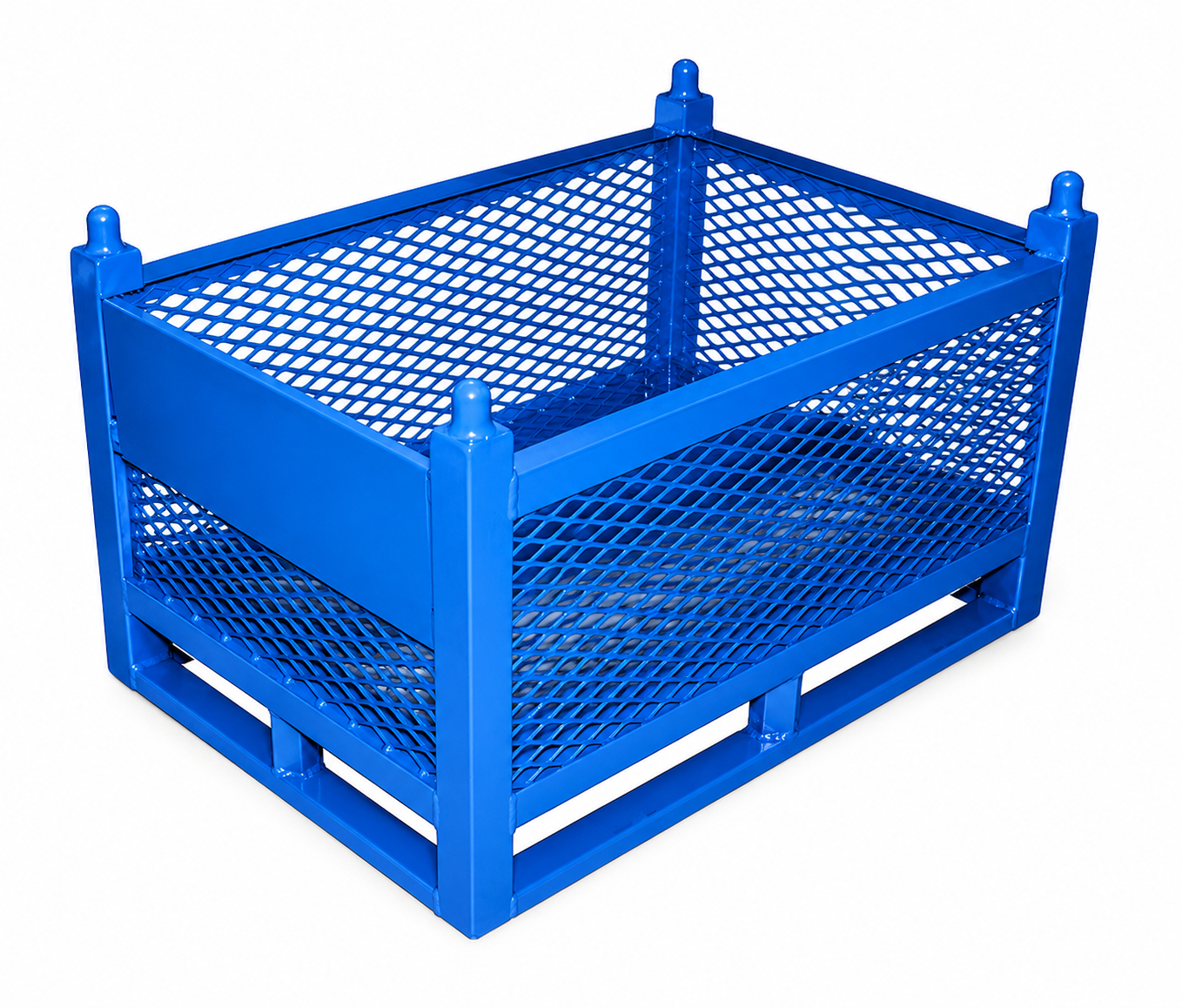
Rigid Steel Container with Perforated Metal Sides: Standard wire mesh works great until the parts you’re storing are smaller than the openings. If a conventional 2″ x 2″ wire mesh pattern is too large, a rigid steel container with perforated metal sides may be a better solution.
You could go to a tighter wire mesh, but smaller mesh can become expensive and may be difficult to find in the thickness needed for demanding industrial use. Perforated steel gives you smaller openings while maintaining a strong, durable side panel. It also provides more open area than a completely solid steel container.
That open area can be important. Some facilities or insurance carriers may require containers to provide a certain percentage of openings as part of their fire protection requirements. Don’t assume one perforation pattern meets every requirement. Verify what applies in your facility before ordering the container.
These containers are typically used in automotive plants, foundries, and other manufacturing operations handling small but heavy metal components. A heavy steel bottom panel takes the abuse. If you’re dropping castings and other dense parts into a container all day, that’s exactly what you want it to do.
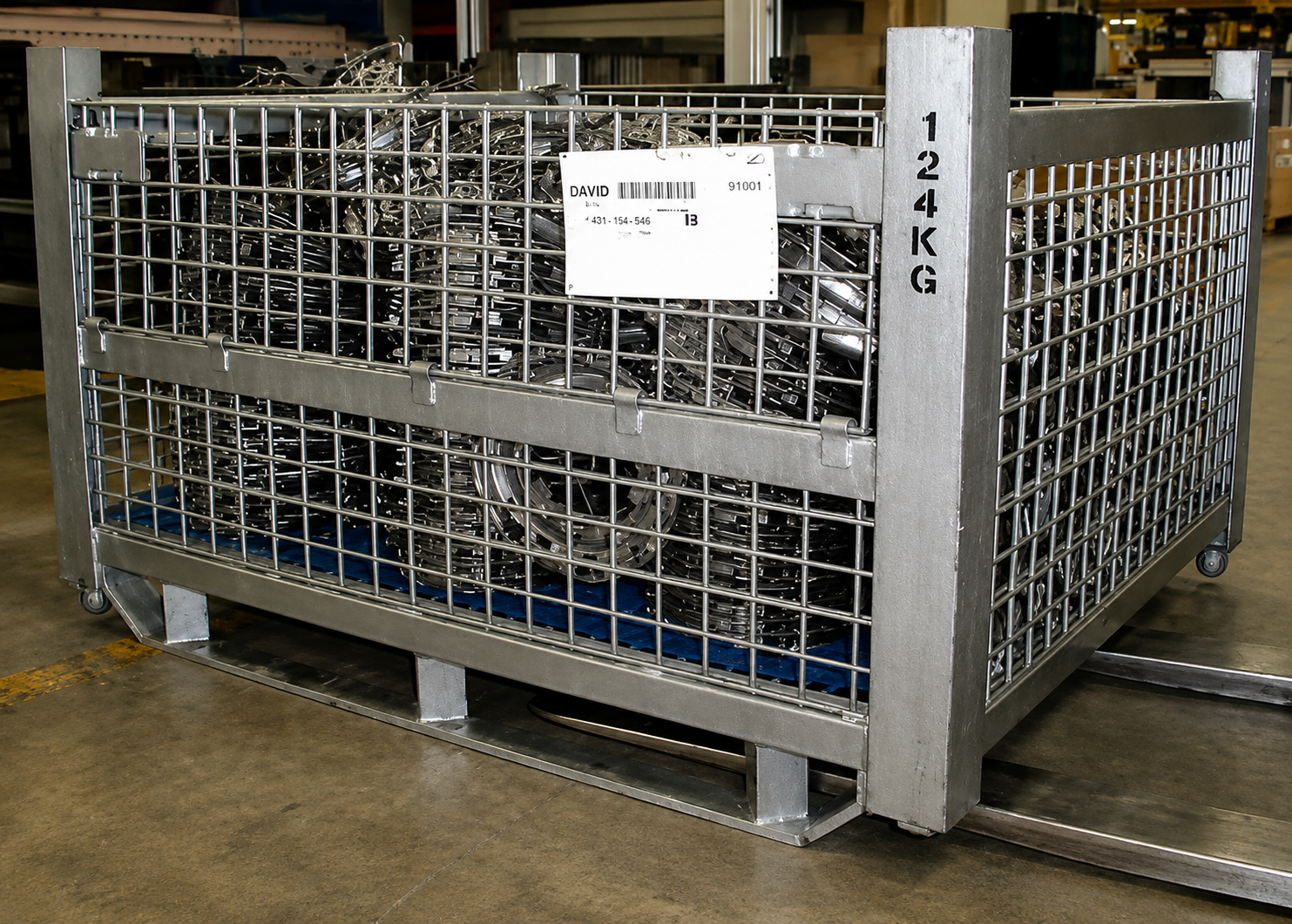
Some applications will destroy an average wire container. Heavy-duty rigid wire mesh containers are designed for those applications.
These containers share many of the same characteristics found in heavy-duty automotive containers such as the Ford ZE-13 and GM-5131. They use robust steel framing and heavy wire construction designed to survive repeated loading, stacking, forklift handling, and the general abuse that comes with automotive and industrial material handling. They’re not our least expensive wire containers, and they’re not supposed to be. You’re buying them because you don’t want to keep replacing cheaper containers.
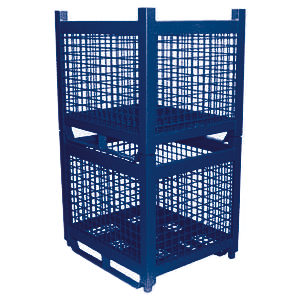
Another advantage is customization. Heavy-duty rigid wire bins can be designed to match and stack with containers already in your operation. One example measures 40″ x 48″ x 30″ outside with approximately 38″ x 45.5″ x 23.5″ of usable inside space. It uses 3″ x 3″ x 3/16″ steel angle corner posts with stacking plugs on the bottom and receiving pockets at the top. Two half drop gates on the 48″ sides provide access, while two steel runners provide additional support underneath.
If you already have a fleet of specialty containers, compatibility matters. Measure the existing containers, stacking points, usable dimensions, runners, and gate locations before designing replacements. Getting “close” isn’t good enough if the new container needs to stack with the old one.
Heavy-duty rigid wire containers are popular in the automotive industry for a pretty straightforward reason: they’re built to last. Manufacturing plants are hard on material handling equipment. Forklifts hit containers. Heavy parts get dropped into them. Containers are moved, loaded, stacked, unloaded, and moved again. A properly designed rigid wire container is built with that abuse in mind.
These containers can help reduce product damage while increasing storage density and handling efficiency. Depending on the design, they can hold loads up to 4,000 lbs. and stack four to five high. That lets you get heavy parts off the floor and use the vertical space you are already paying for.
Standard stock sizes are available, but custom containers can be manufactured when a standard size doesn’t make sense. Whether you’re storing small parts, large components, or heavy castings, the container should be designed around the product weight, dimensions, loading method, forklift requirements, stacking height, and how it moves through your facility.
Our heavy-duty rigid wire containers are manufactured in the USA at a 150,000-square-foot facility in St. Louis, Missouri. Automated robotic welding provides consistent weld quality, while an in-house powder coating line allows the containers to be finished for demanding industrial service. A heavy-duty container costs more than a lightweight basket. But if it lasts years longer in your application, that’s the number that really matters.
Specialty Rigid Wire Containers FAQ
How do I know if I need a specialty heavy-duty container instead of a standard wire basket?
Look at what is happening to the containers you already have. If frames are bending, floors are failing, stacking feet are getting damaged, or wire panels aren’t holding up to the load, moving to heavier construction may make sense. Heavy castings, automotive components, repeated forklift handling, and demanding closed-loop applications are all good reasons to consider a specialty rigid container. Don’t buy more container than you need, but don’t keep replacing a container that was never heavy enough for the job.
Can a new rigid wire container be designed to stack with containers I already own?
Yes, but we need accurate information. Outside dimensions are only part of the equation. Stacking plugs, pockets, corner posts, runners, gate locations, and other details may determine whether two containers actually stack together. When compatibility with an existing fleet is important, providing drawings or a sample container can help eliminate guesswork.
What should I consider when designing a specialty rigid wire container?
Start with the load. Determine the size, shape, weight, and quantity of the material being stored. Then look at how the container will be loaded, picked, transported, stacked, and unloaded. Consider forklift entry, drop gates, runners, solid versus wire or perforated sides, stacking height, usable inside dimensions, and whether overhead lifting is required. The best container isn’t necessarily the one with the most features. It’s the one designed around what actually happens on your plant floor.




