Steel Shelving Standard Sizes
Industrial steel shelving is a modular storage system constructed with steel posts, shelves, and supports for hand-loaded parts, boxes, tools, supplies, and other warehouse inventory. Unlike boltless shelving, traditional steel shelving typically uses clips, fasteners, or other connections to secure the shelves to the uprights. Adjustable shelf levels, open or closed configurations, solid steel shelves, dividers, bins, and other accessories allow the system to be configured around the products being stored. Standard 36″ and 48″ widths with 18″ and 24″ depths cover a lot of warehouse storage applications. The trick isn’t finding steel shelving. It’s choosing the right size so you’re not paying for space you don’t use—or wishing six months from now that you had another six inches of shelf.
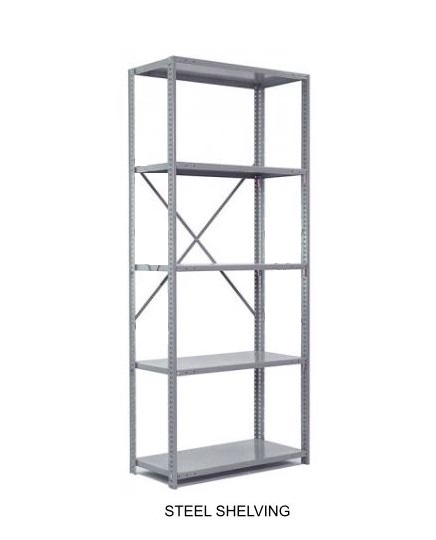
36″ w. x 18″ d. x 87″ h. Industrial Steel Shelving w/ 5 Shelves
The 36″ x 18″ x 87″ five-shelf unit is a good general-purpose size when floor space is limited or the products being stored don’t require a deep shelf. The narrower 36″ width also keeps shelf spans relatively short, making this configuration useful for parts, tools, cartons, supplies, records, and other hand-loaded inventory.
Showing all 4 resultsSorted by latest
36″ w. x 18″ d. x 87″ h. Industrial Steel Shelving w/ 5 Shelves
36″ w. x 24″ d. x 87″ h. Industrial Steel Shelving w/ 5 Shelves
48″ w. x 18″ d. x 87″ h. Industrial Steel Shelving w/ 5 Shelves
48″ w. x 24″ d. x 87″ h. Industrial Steel Shelving w/ 5 Shelves
At 87″ high, the unit takes advantage of vertical storage space without requiring a huge footprint. Adjustable shelves let you change the spacing around the inventory instead of wasting clearance between levels. If your products fit comfortably on an 18″ deep shelf, there’s no reason to buy 24″ of depth and give up another six inches of aisle or floor space.
36″ w. x 24″ d. x 87″ h. Industrial Steel Shelving w/ 5 Shelves
Move from 18″ to 24″ deep and you gain more room for larger boxes, parts, tools, bins, and supplies while keeping the same 36″ shelf width. This makes the 36″ x 24″ x 87″ configuration useful in manufacturing, warehouses, automotive facilities, stockrooms, maintenance departments, and other applications where products need a little more shelf depth.
The additional depth can also make it easier to organize containers and parts front to back. But deeper isn’t automatically better. If employees have to reach behind one product to find another, you’ve created a picking problem instead of solving a storage problem. Match the depth to the inventory and how employees actually access it.
48″ w. x 18″ d. x 87″ h. Industrial Steel Shelving w/ 5 Shelves
The 48″ x 18″ x 87″ five-shelf unit provides more shelf width without taking up additional aisle depth. That makes it a good choice for longer items or applications where you want to increase storage capacity along a wall or within a row while maintaining an 18″ deep footprint.
Steel shelving can be configured as open or closed units and, depending on the system, single- or double-sided for access from one or both directions. Adjustable shelves allow the spacing to change as inventory changes. The wider shelf gives you more storage per level, but remember that shelf capacity depends on the specific shelving design and configuration. Don’t select shelving based on dimensions alone. Start with what you’re putting on it and how much it weighs.
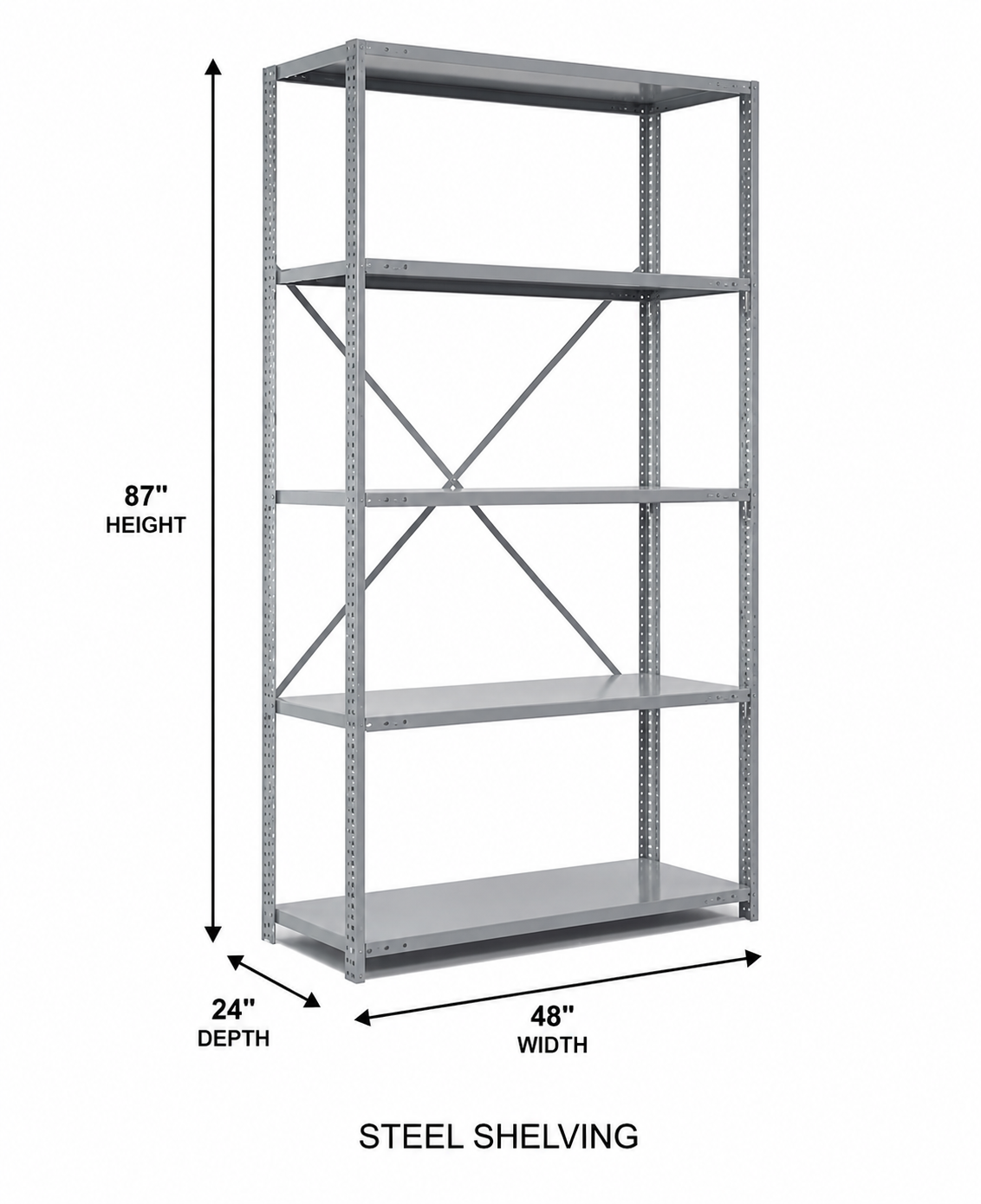
48″ w. x 24″ d. x 87″ h. Industrial Steel Shelving w/ 5 Shelves
The 48″ x 24″ x 87″ configuration gives you the most shelf area of these four standard sizes. It’s a logical choice for larger cartons, bins, maintenance supplies, industrial parts, and other products that need both width and depth. If you have the floor space and the inventory to fill it, the larger footprint can reduce the number of shelving sections required.
This size can also be configured with accessories such as shelf dividers, bins, label holders, and other organizational components. Open shelving provides visibility and access, while closed sides and backs can provide greater separation and containment. Powder-coated finishes are also available on many steel shelving systems for added surface protection.
One of the advantages of steel shelving is that you don’t have to stop with five empty shelves. Dividers can separate parts or product categories. Boxes and bins keep smaller inventory contained. Label holders make SKU identification and picking easier. Depending on the shelving system and application, closed sides and backs can also be added to provide greater product separation.
Mobile configurations may be available with casters, but mobility changes how the shelving is loaded and used. Caster type, shelving capacity, floor conditions, total unit weight, and stability should all be considered before turning a stationary shelving unit into a rolling one. Just because you can put wheels underneath something doesn’t mean you should.
Industrial steel shelving is used anywhere products need to be stored individually and picked by hand. Manufacturing facilities use it for parts, tools, and supplies. Warehouses and distribution centers use it for boxes, bins, and inventory. Automotive operations use it for replacement parts and maintenance supplies, while retail stockrooms use it to organize reserve inventory.
Steel shelving is also used for records, packaged products, laboratory and medical supplies, and other applications where adjustable shelf spacing and organized storage are important. The best configuration depends on product size, weight, access requirements, environment, and available space. That’s why the load should come first and the shelving second.
Steel Shelving Standard Sizes FAQ
Should I choose 18″ or 24″ deep steel shelving?
Measure what you’re storing. An 18″ deep shelf works well for smaller boxes, parts, supplies, and bins while preserving aisle and floor space. A 24″ shelf provides more room for larger products. Don’t automatically buy the deepest shelf available. Extra depth isn’t useful if it just creates dead space behind your inventory.
Is 36″ or 48″ wide shelving better?
A 36″ wide unit provides a shorter shelf span and can fit into smaller areas. A 48″ wide unit provides more storage space per shelf and may reduce the number of shelving sections needed. Product dimensions, shelf loads, available wall or row length, and the rated capacity of the specific shelving system should determine the width.
What accessories should I add to steel shelving?
Only the ones that solve a problem. Use dividers when products need separation, bins for loose parts, and label holders when SKU identification matters. Closed sides or backs can help with containment or separation. The goal isn’t to see how many accessories you can add. It’s to make the shelving easier to use.




