Specialty Steel Containers
Specialty steel containers are heavy-duty material handling containers designed for applications where a standard bulk container simply won’t do the job. They can be built from solid, corrugated, perforated, or stainless steel and configured for stacking, dumping, crane lifting, forklift handling, food processing, or storing unusual parts and materials. Depending on the application, containers can include drop bottoms, open sides, fork pockets, lifting lugs, gates, drains, and other features. The advantage is simple: instead of changing your operation to fit the container, you can build the container to fit your operation.
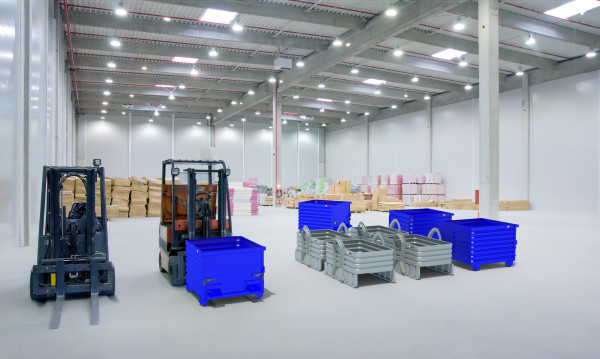
Custom Heavy Duty Material Handling Steel Bulk Containers
Sometimes an off-the-shelf steel container works. Sometimes it doesn’t. Custom heavy-duty material handling steel bulk containers can be designed around the size, weight, shape, handling method, and storage requirements of the products you need to move.

Showing all 9 resultsSorted by latest
Custom Heavy Duty Material Handling Steel Bulk Containers

Gravity Feed Stand for Drop Bottom Corrugated Steel Containers
Drop Bottom Corrugated Steel Containers
Box Dumper Forklift Attachment for Drop Bottom Steel Containers
D-1L Round Corner Drop Bottom Steel Containers
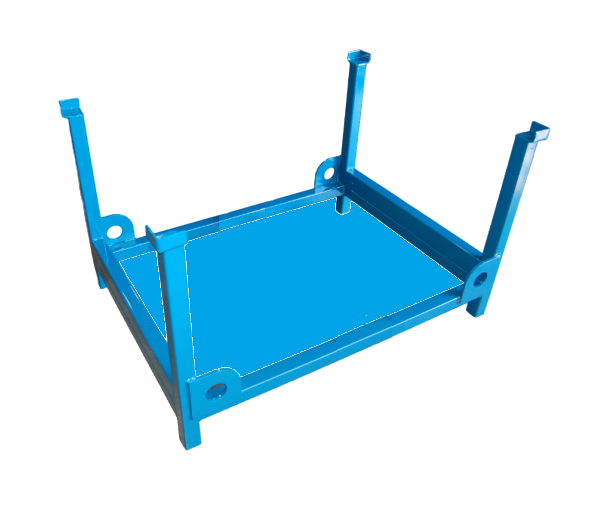
Stackable Steel Container with Open Sides | Stackable Cradle Rack
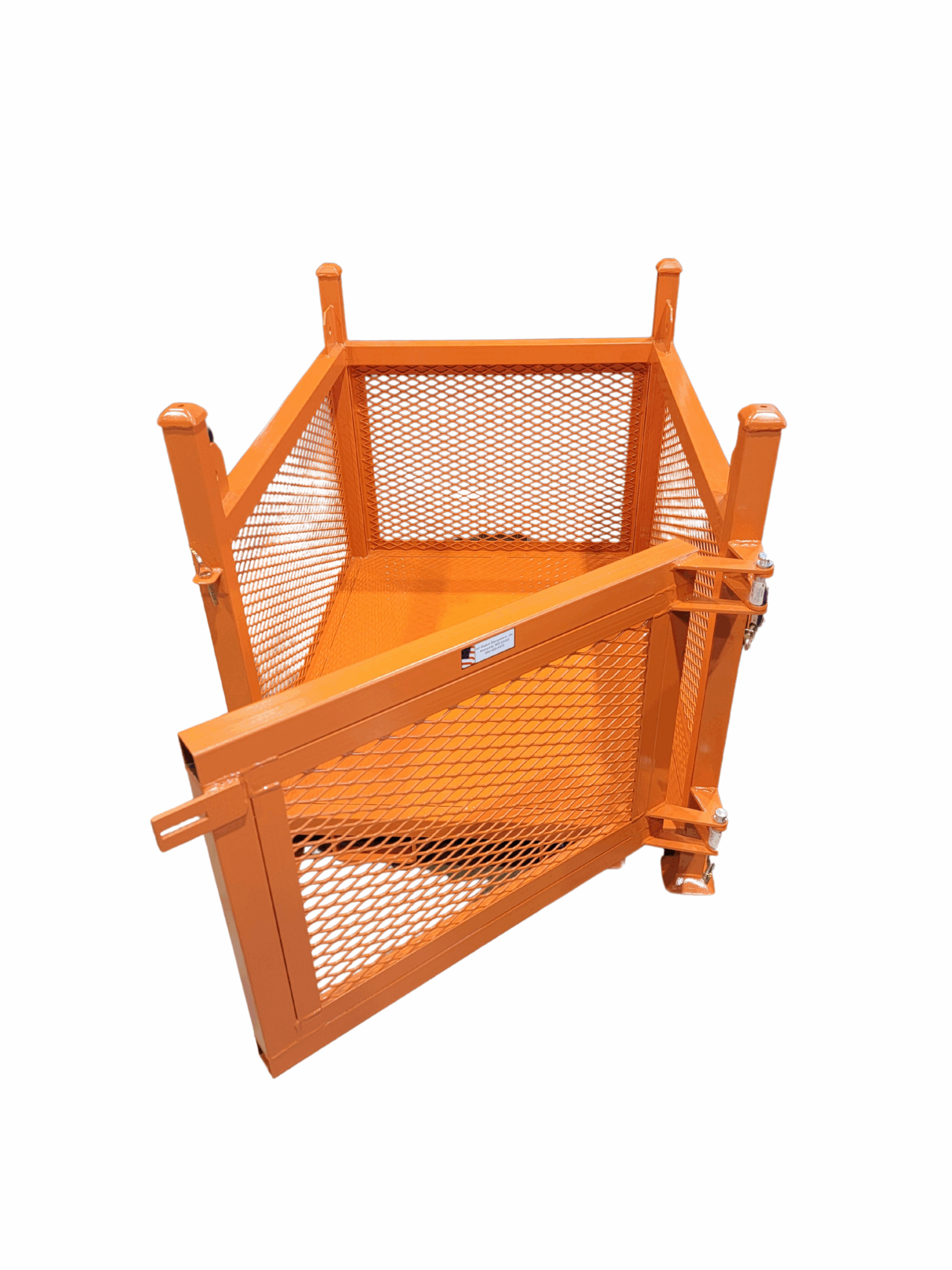
Crane Lift Cage with Swing Out Gate
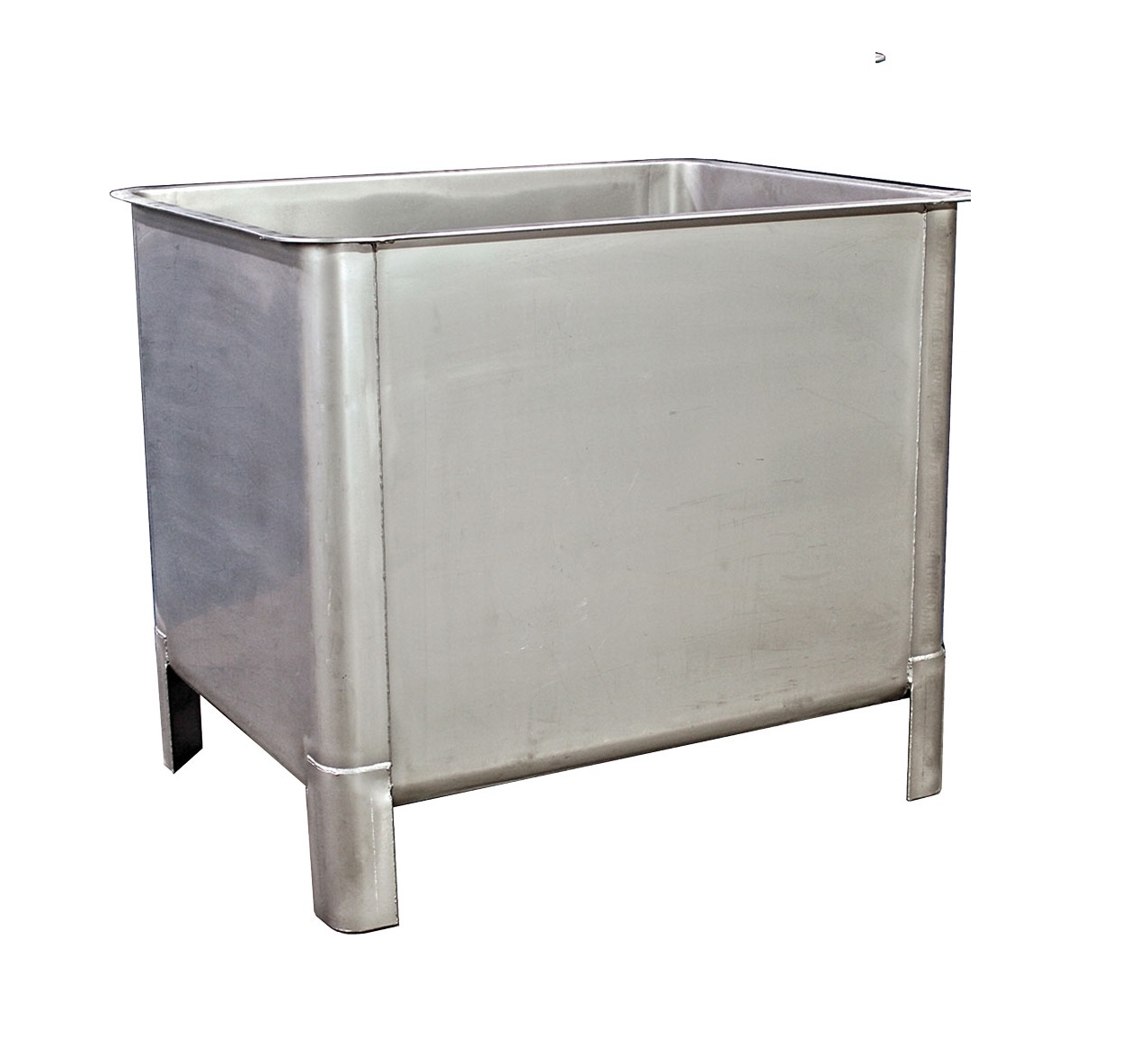
Stainless Steel Vats for the Food Processing Industry
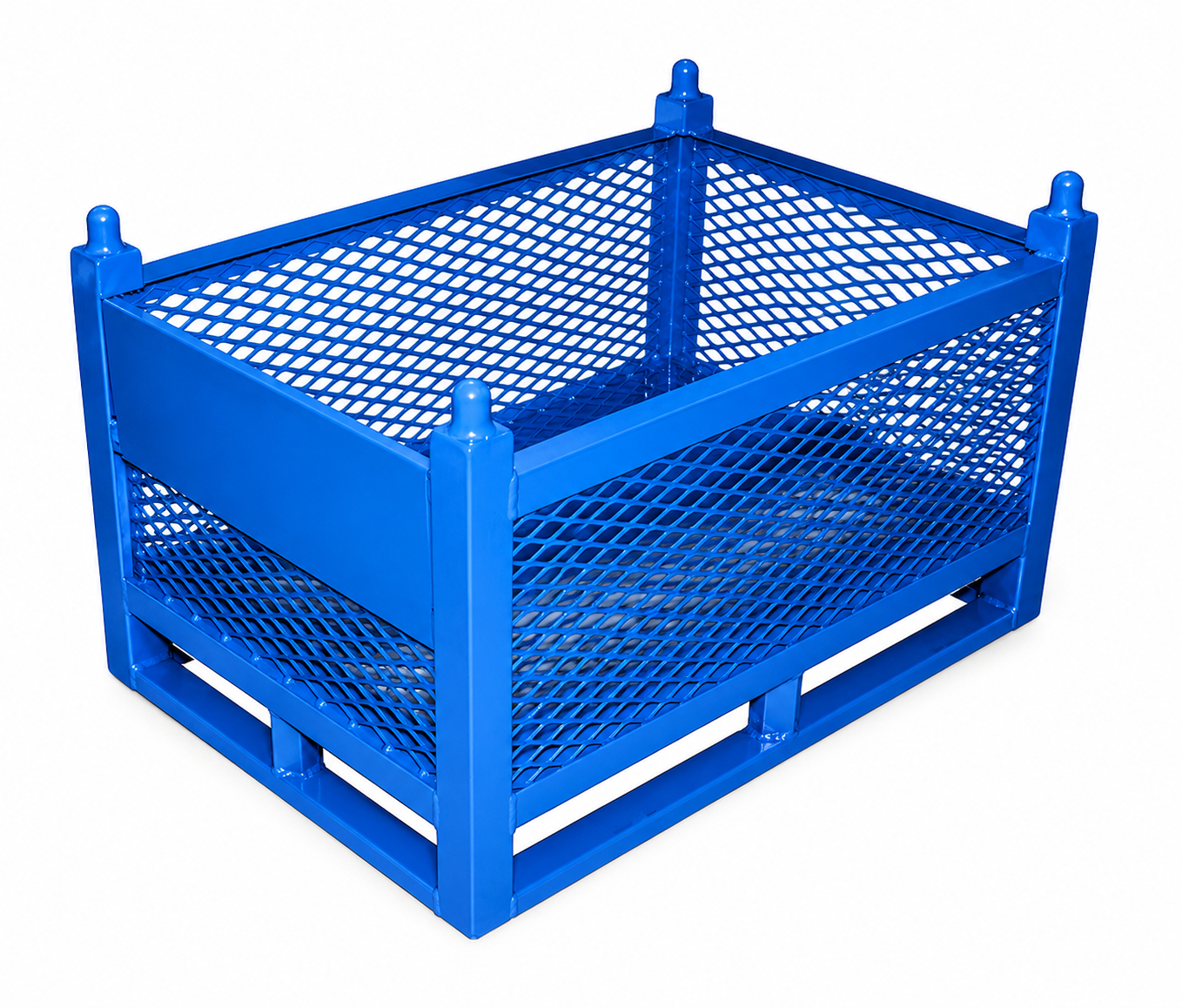
Rigid Steel Container with Perforated Metal Sides
Containers can be rigid, collapsible, or stackable and built with solid, corrugated, or other steel construction. Existing containers can also be replicated or modified when you already have a design that works. Important considerations include usable inside dimensions, overall height, load capacity, stacking requirements, and two-way or four-way forklift entry. Spending a little more time on the design can save a lot of money later in damaged products, inefficient handling, repairs, and replacement containers.
Gravity Feed Stand for Drop Bottom Corrugated Steel Containers
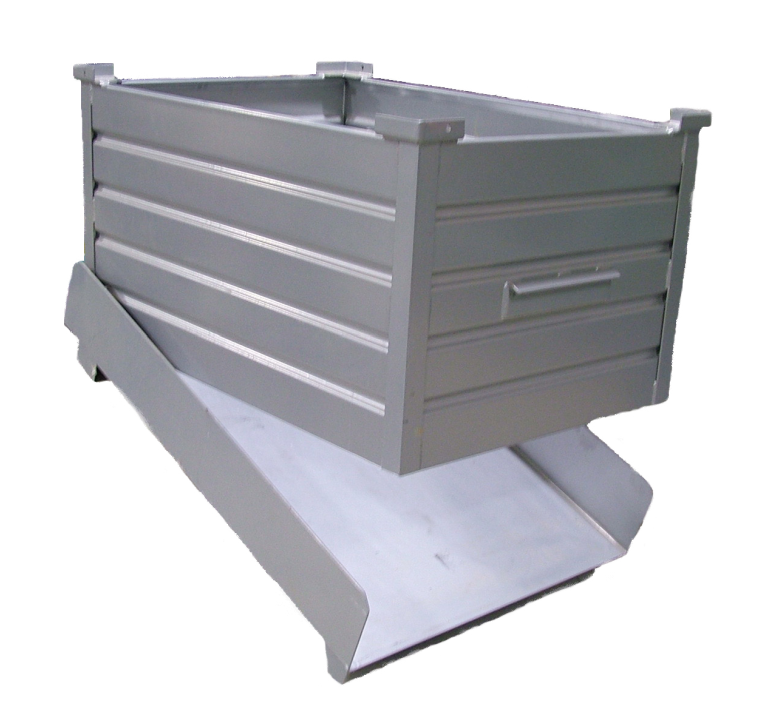
Our gravity feed stands work with drop bottom corrugated steel containers to create a simple but very efficient parts handling and picking system. The container can be filled, stacked, transported, and handled like a conventional steel bulk container until it is placed onto the stand.
Once the container is positioned on the gravity feed stand, the stand engages the container and allows its hinged bottom to open. Parts drop into a trough with an open hopper front, putting the contents at a convenient picking height. Instead of workers repeatedly reaching and bending into a deep container, the parts come to them. It is a straightforward way to improve picking efficiency and ergonomics.
TIP FROM THE PROS: Drop bottom corrugated steel containers are designed to work with a compatible gravity feed stand or drop bottom box dumper attachment.
Drop Bottom Corrugated Steel Containers
Drop bottom corrugated steel containers give you the strength and durability of a traditional steel bulk container with a much faster way to unload it. They can be loaded, stacked, stored, and transported throughout a manufacturing facility just like conventional containers.
The difference becomes apparent when the container is placed onto a compatible gravity feed stand. The bottom disengages and the parts fall into the hopper below, where workers can access them more easily. For operations handling large quantities of small metal parts, fasteners, castings, and similar materials, this can eliminate a lot of reaching, bending, stooping, and manual unloading.
Box Dumper Forklift Attachment for Drop Bottom Steel Containers
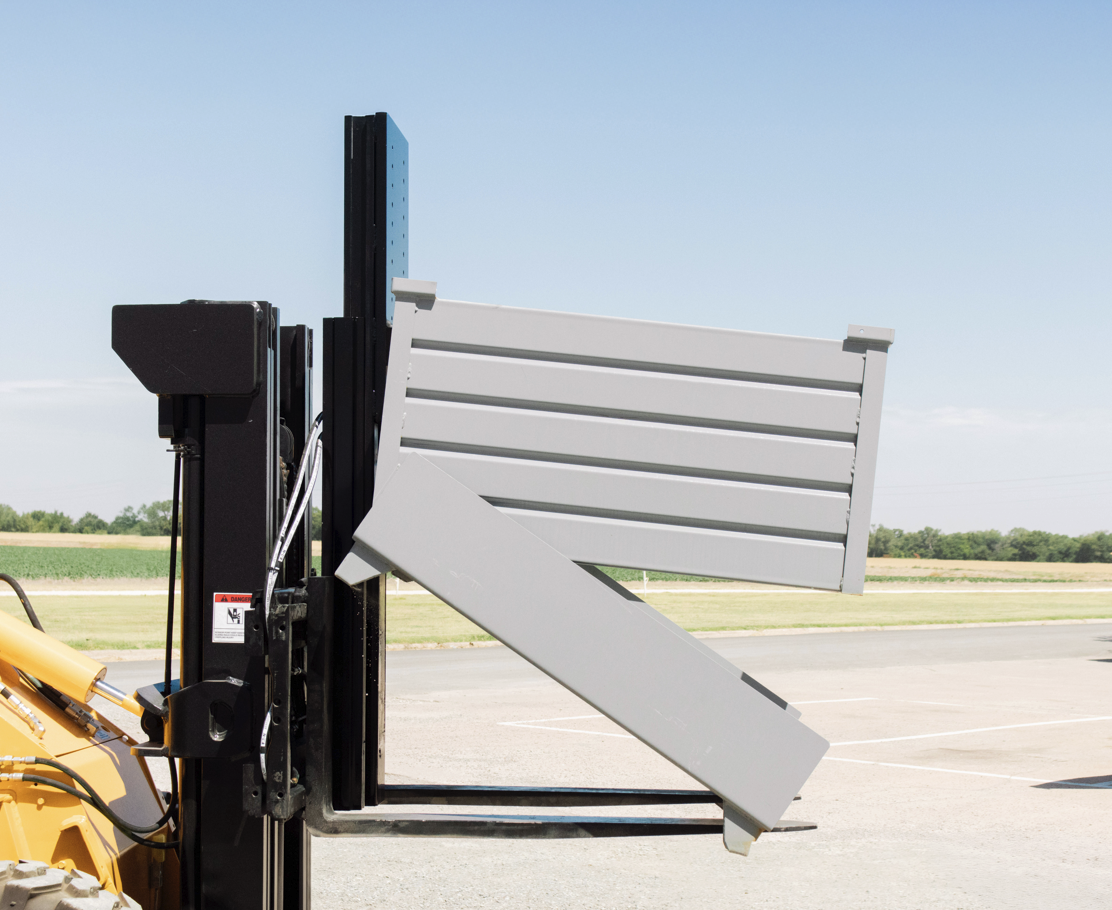
A gravity feed stand is stationary. A box dumper forklift attachment brings the unloading system to wherever you need it.
The hydraulically operated attachment mounts to the carriage of an existing forklift and works with compatible drop bottom steel containers. An operator can lift, move, stack, and dump a container from the forklift seat, discharging material into pick stands, hoppers, gondolas, other containers, or designated dumping areas. This makes it useful for metal parts, castings, nuts and bolts, bulk materials, scrap, and trash.
The big advantage is reduced handling. Instead of manually unloading the bottom of a heavy container, one operator and one forklift can move the container and discharge its contents. That saves time while reducing the bending, reaching, lifting, and straining associated with hand unloading.
D-1L Round Corner Drop Bottom Steel Containers
The D-1L Round Corner Drop Bottom Steel Container is built for scrap, bulk materials, castings, and heavy industrial parts. Its heavy steel construction and rounded corners provide strength while eliminating sharp corners that can damage equipment or create unnecessary hazards around the container.
The drop bottom provides quick, controlled unloading without having to tip the entire container. Once discharged, the bottom closes and locks so the container can go right back into service. D-1L containers can also be stacked and handled by forklift or pallet jack, making them well suited for automotive plants, foundries, metalworking operations, recycling facilities, and other demanding manufacturing environments.
Stackable Steel Container with Open Sides
What do you call a steel container with no sides? In many applications, you call it a stack rack.
These stackable steel containers use rigid welded corner posts with an open or solid steel deck. One, two, three, or even four sides can be left open depending on how the product needs to be loaded. The open design makes them particularly useful for long or awkward products such as tubing, pipe, hose, boards, windows, and other materials that are easier to load from the side.
Open-sided stack racks can be handled by forklift and, when properly designed for the application, may also accommodate overhead handling. They stack vertically to help reclaim floor space and can be mixed with closed-sided steel containers where appropriate. They are also useful for transporting products on trailers because the same rack can be used for storage and material movement.
Crane Lift Cage with Swing Out Gate
A crane lift cage with a swing-out gate provides secure storage with multiple ways to handle the container. Heavy-duty steel construction protects the contents, while perforated sides provide visibility and ventilation. The swing-out gate gives workers wide access for loading and unloading and can be secured before the cage is moved.
Integrated lifting lugs provide an overhead handling point, while fork pockets and a reinforced base allow forklift handling. This combination can be useful in manufacturing plants, warehouses, construction operations, and other facilities where materials need to move between different work areas using different types of equipment.
Because overhead lifting places very different demands on a container than ordinary forklift handling, crane lift cages need to be engineered for the intended load and lifting method.
Stainless Steel Vats for the Food Processing Industry
Stainless steel vats are widely used in food processing because they are durable, easy to clean, and easy to sanitize. Unlike painted carbon steel, stainless steel is particularly well suited for operations where cleanliness and repeated washdowns are part of everyday production.
Standard and custom food-grade stainless steel vats can be manufactured for storage, handling, and transportation applications. The models described here have a 2,000-lb capacity, 12-gauge stainless steel body, 1-1/2-inch hemmed formed rim, 11-gauge enclosed legs providing 5 to 7 inches of floor clearance, and are available with or without a drain plug. Stainless steel isn’t the cheapest option, but when sanitation, durability, and long service life matter, cheap usually isn’t the goal.
Rigid Steel Container with Perforated Metal Sides
Standard 2″ x 2″ wire mesh works well for many bulk containers, but smaller parts can slip through the openings. Going to much tighter wire mesh can become expensive and may not provide the thickness needed for demanding industrial applications. Perforated steel provides another option.
Rigid steel containers with perforated metal sides combine smaller openings with the strength of a steel-sided container. The perforations also provide more open area than a completely solid container, which may be important where facility or insurance requirements call for containers with greater open area for fire protection considerations.
These containers are commonly used for metal components and other small, heavy industrial parts. A heavy steel bottom allows them to take the abuse that comes with demanding applications—including foundries and metalworking operations where heavy castings may be dropped directly into the container.
Specialty Steel Container FAQ
Can a specialty steel container be designed around an existing container?
Yes. If you already have a container that works well, it can serve as the starting point for a new design. Existing designs can be replicated or modified for different dimensions, capacities, forklift entry, stacking requirements, gates, open sides, or other operational needs.
What information is needed to design a custom steel container?
Start with what you are putting in it. Consider the size, shape, and weight of the product; usable inside dimensions; required load capacity; overall container dimensions; stacking requirements; and whether you need two-way or four-way forklift entry. You should also consider how the container will be loaded, unloaded, transported, stored, and returned when empty.
Do drop bottom containers require special equipment?
Yes. The drop bottom corrugated steel containers described here are designed to operate with a compatible gravity feed stand or box dumper forklift attachment. The stand is a good choice for a fixed picking location, while the forklift attachment provides a portable dumping solution.
What should I consider before ordering a specialty steel container?
Don’t start with the container. Start with the application. Look at the product being stored, how much it weighs, how employees handle it, how the container will be moved, whether it needs to stack, and how it will be unloaded. Also consider sanitation, fire protection, forklift access, overhead lifting requirements, and any facility or insurance requirements that may apply. A properly designed specialty container should solve a material handling problem—not create another one.




