Rigid Wire Container Applications
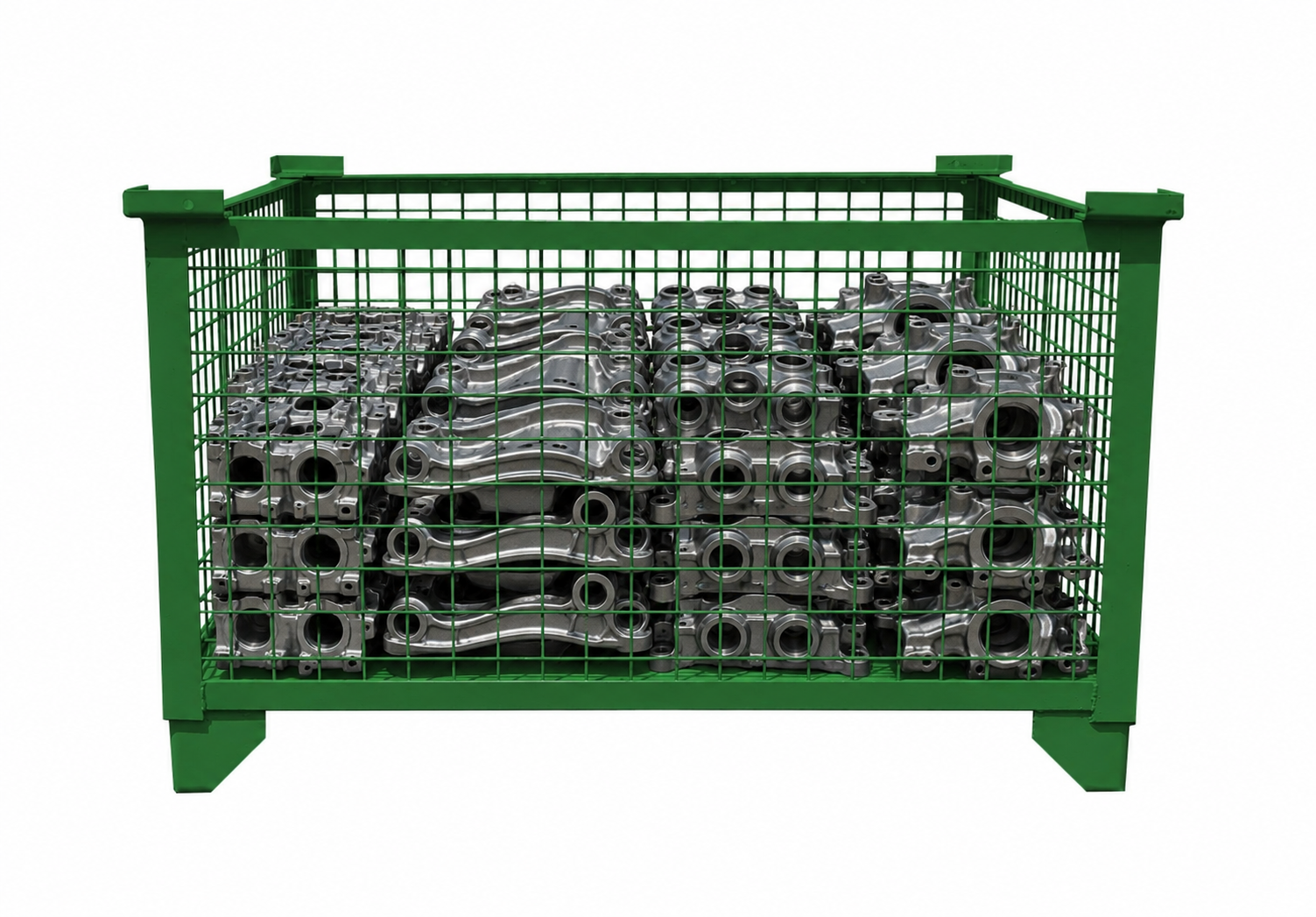
Rigid wire container applications range from metal stamping and automotive manufacturing to returnable packaging, fire-conscious storage, and high-bay pallet rack systems. These heavy-duty steel and wire containers are designed to store, protect, transport, and present parts throughout manufacturing and distribution operations. Their rigid construction handles heavy loads and repeated forklift use, while open wire sides provide visibility and, where required by the facility design, greater openness than solid-sided containers. Stackable designs increase storage density, and custom features such as drop gates, dividers, runners, and lifting provisions can make handling easier. The real advantage is versatility. A properly designed rigid wire container doesn’t just hold parts. It becomes part of the material handling system.
Metal Stamping Companies Rely on Heavy Duty Steel & Wire Containers
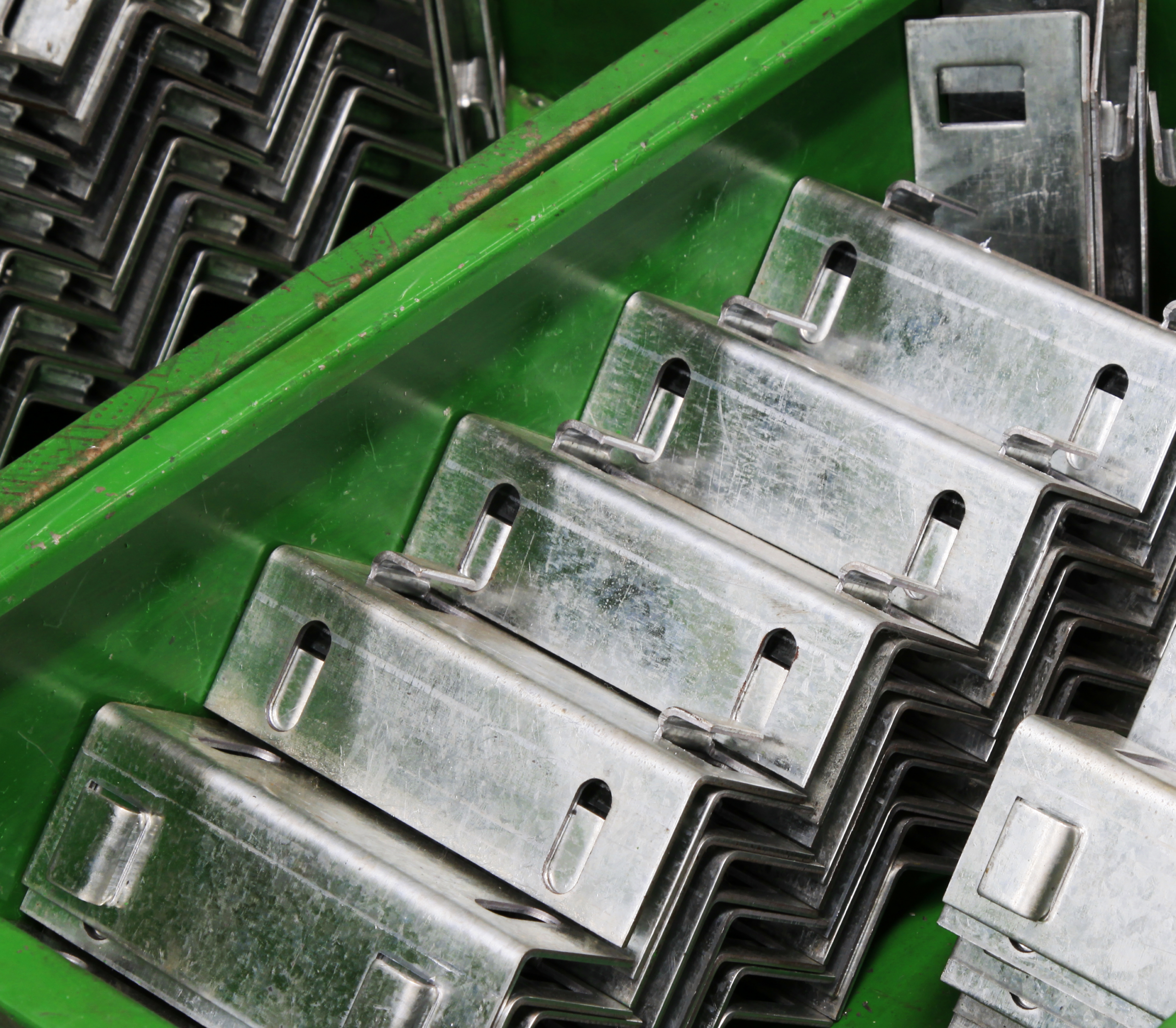
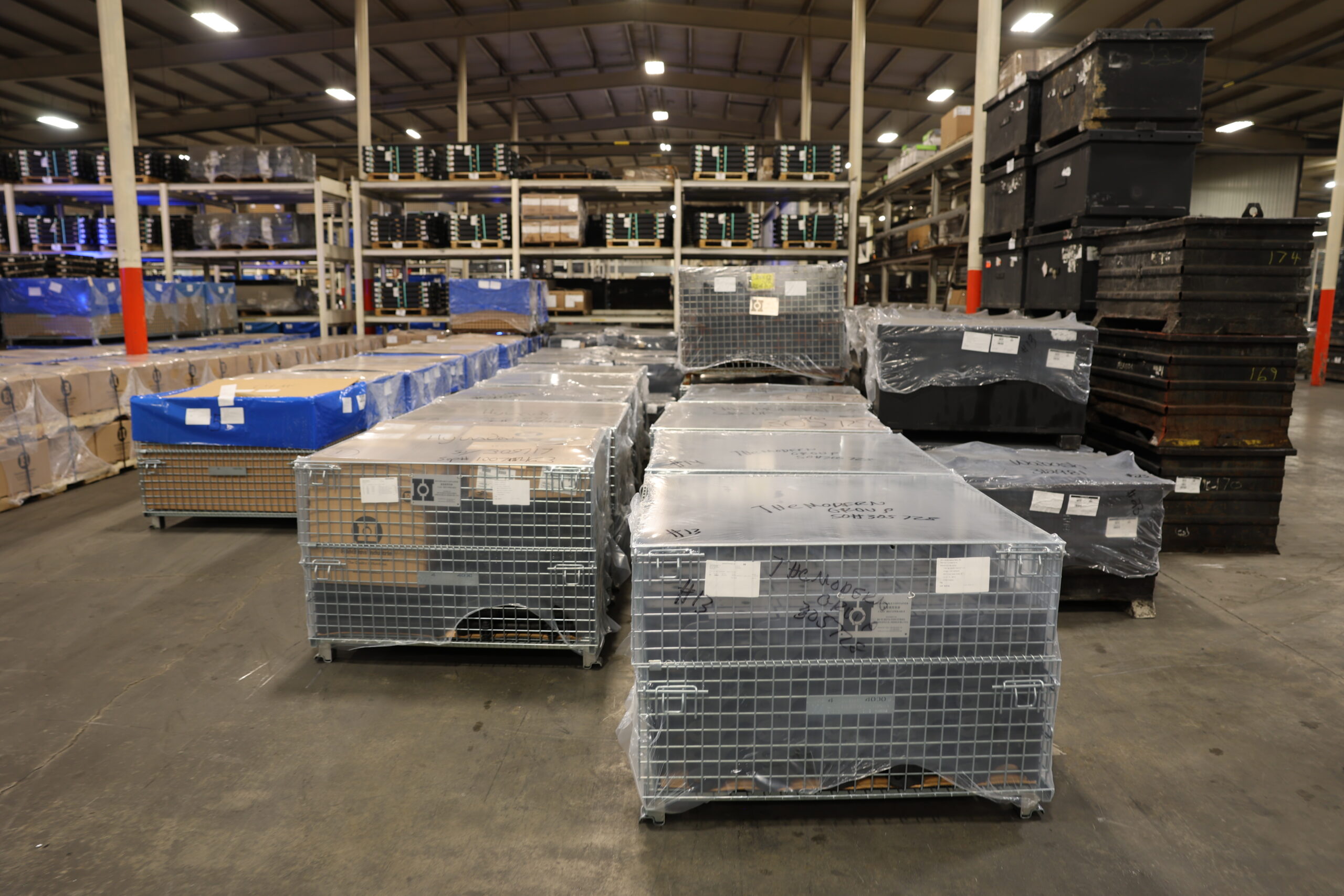
Metal stamping is hard on material handling equipment. Heavy sheets, stampings, blanks, and finished metal parts need containers that can take the weight and survive repeated movement between presses, work cells, storage areas, and subsequent operations. Heavy-duty steel and rigid wire containers are built for exactly that kind of environment.
Showing all 5 resultsSorted by latest
Metal Stamping Companies Rely on Heavy Duty Steel & Wire Containers
Automotive Industry Relies on Wire Containers & Steel Bins
Returnables | Plastic, Steel & Wire Containers used as Returnable Packaging
Convert Plastic Bulk Containers to 45″ d. x 48″ w. x 34″ h. Steel & Wire Bulk Containers for Fire Safety
Rackable Rigid Wire Baskets & Steel Containers for Storage in High Bay Pallet Racking
These containers do more than hold stamped parts. They help present those parts to the next operation while protecting finished components from scratches, dents, and other handling damage. Rigid construction keeps the container stable under heavy loads, while stackable designs let manufacturers store vertically instead of filling valuable production floor space with rows of containers.
Metal stamping operations also tend to have very specific requirements. A container that works for one stamping may be completely wrong for another. Dimensions, load capacity, gates, dividers, shelves, runners, and other features can be designed around the part and the manufacturing process. If you’re constantly fighting an off-the-shelf container, there’s a good chance you need a container designed around the application.
Automotive Industry Relies on Wire Containers & Steel Bins
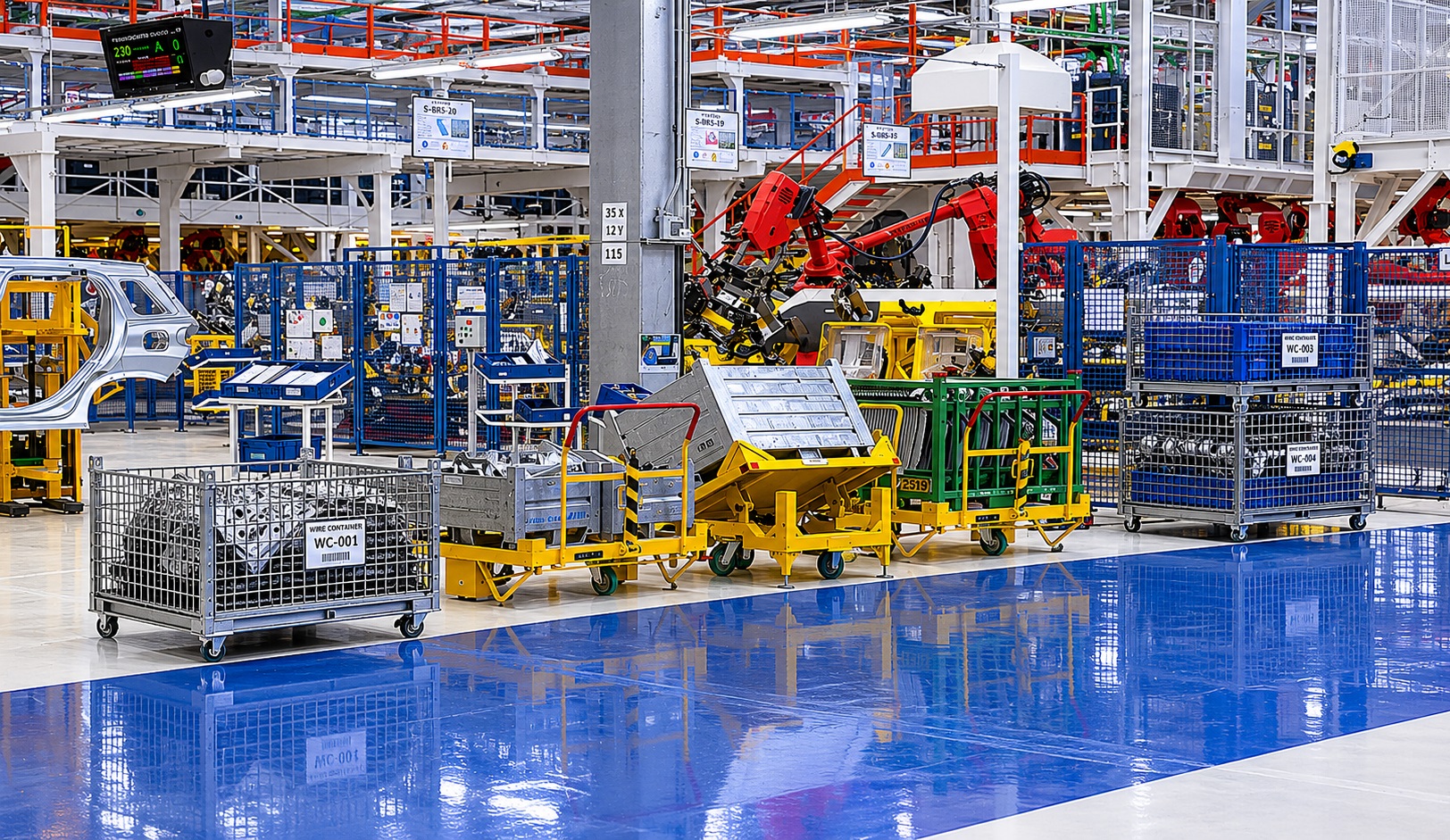
The automotive industry has relied on steel bins, wire containers, racks, and returnable packaging for decades. There is a good reason for that. Modern automotive plants move an enormous number of components through suppliers, manufacturing operations, assembly plants, and distribution networks. The packaging has to keep up.
Rigid wire containers and steel bins provide the strength needed for heavy automotive components while protecting parts during storage and transportation. Depending on the design, they can handle everything from smaller stamped components to body panels, castings, transmission components, and other heavy parts. Stackable construction also helps manufacturers make better use of floor space while keeping work-in-process inventory organized.
Customization is especially important in automotive applications. Dividers, shelves, dunnage, gates, runners, and other features can be incorporated to protect specific components and present them properly to production workers. The container shouldn’t just survive the trip to the assembly line. It should help the assembly line work more efficiently once it gets there.
Returnable packaging is pretty simple in concept. Ship the product in a reusable container, get the empty container back, and use it again. In practice, a good returnable packaging system requires the container to survive that cycle over and over again.
Plastic, steel, and wire containers are commonly used in closed-loop systems where parts move between suppliers, manufacturers, distributors, and customers. Standardized footprints make containers easier to stack, store, transport, and account for. Wire construction provides visibility, while steel construction provides the durability needed for demanding industrial products.
The economics are where returnables really start to make sense. Corrugated boxes may cost less initially, but they have to be replaced. A well-designed steel or wire container can make hundreds or even thousands of trips depending on the application and how it is handled. It can also provide better protection for expensive components, reducing product damage along the way.
But don’t look only at the outbound shipment. Think about the empty return trip too. How many empties fit on a truck? Where are they stored? Do they need to collapse? How will they be tracked? Returnable packaging works best when you design the entire loop, not just the trip from Point A to Point B.
Steel & Wire Bulk Containers for Fire Safety
Storage container material and design can become an important consideration when a facility evaluates its fire protection system. Solid plastic bulk containers can present different fire and sprinkler challenges than open wire containers, and solid-sided containers can interfere with water distribution depending on how and where they are stored.
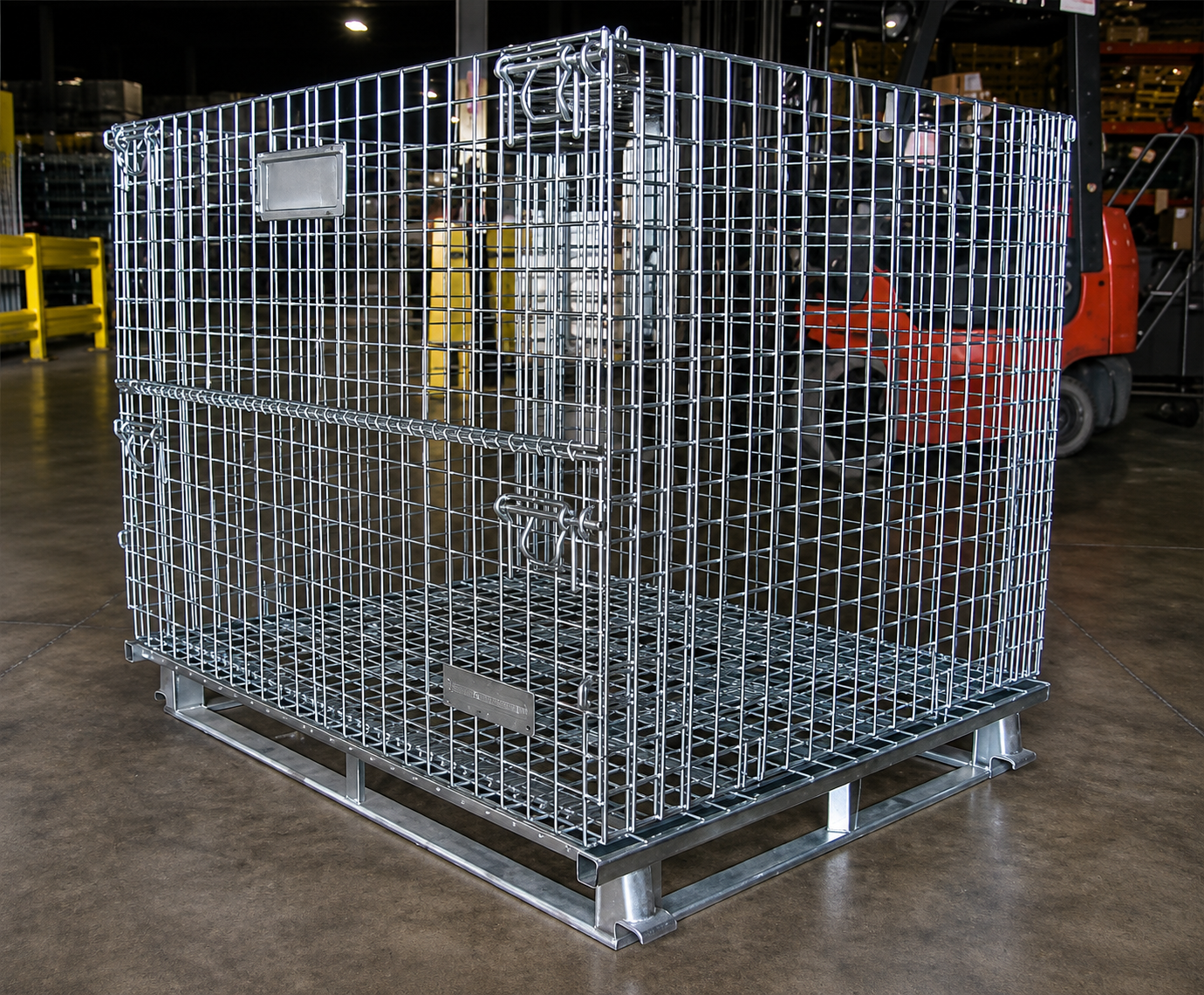
For facilities looking to replace plastic bulk containers, steel and wire containers may provide an alternative. A common plastic bulk container footprint of approximately 45″ deep x 48″ wide x 34″ high, for example, can potentially be replaced with a similarly sized steel or wire container while maintaining the basic material handling footprint.
Open storage components may also be considered as part of the overall rack design. Products such as 50% open punched steel decking, pallet spacers, and properly maintained flue spaces can help support a storage arrangement designed around sprinkler performance.
But fire protection isn’t something you should design from a web page. Requirements vary by commodity, storage height, container material, sprinkler system, rack configuration, jurisdiction, insurer, and other factors. Before replacing containers or changing rack decking for fire-safety reasons, work with your fire protection professional, insurance carrier, and the authority having jurisdiction. The goal is to select containers that work with your fire protection design—not assume that any steel or wire container automatically solves the problem.
Rackable Rigid Wire Baskets & Steel Containers for Storage in High Bay Pallet Rack
If rigid wire baskets can stack on themselves, why put them in pallet rack? One word: selectivity.
Stack four containers on the floor and the top one is easy to reach. Need the bottom one? Now you’re moving three containers just to get to it. Put those same containers into properly designed pallet rack positions and each container can be independently accessed from the aisle. That’s a big advantage when you’re storing multiple SKUs or work-in-process parts that need to be retrieved in no particular order.
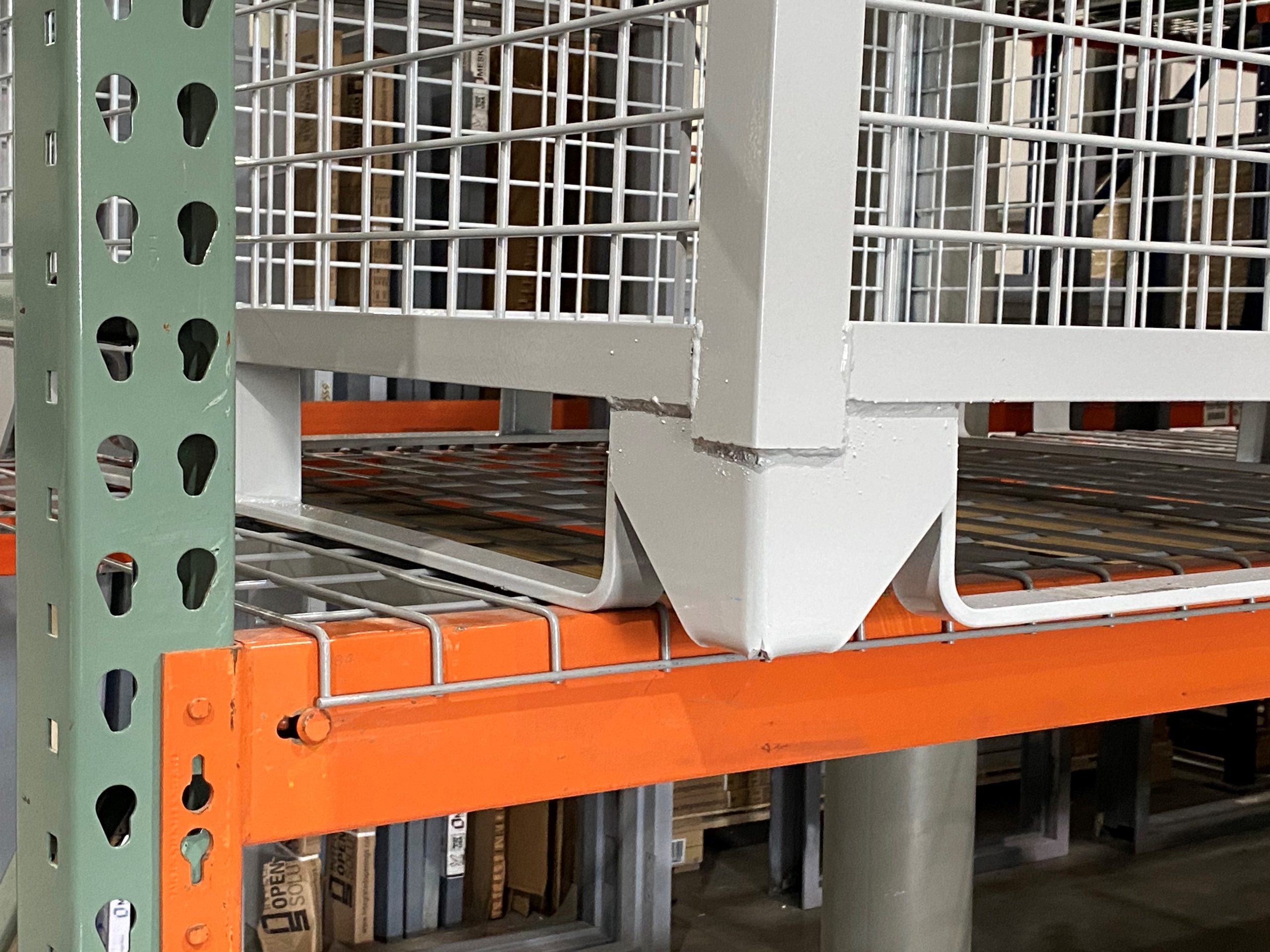
But putting a rigid wire basket or steel container into pallet rack isn’t as simple as setting it on a shelf. Many containers have feet, and those feet concentrate the weight into relatively small areas. That’s a point load. Put a heavily loaded container with four small feet onto decking that wasn’t designed for those loads and you can damage the decking or create a much bigger problem.
Container width matters too. Two 48″ wide containers do not give you comfortable clearance on a 96″ beam just because the math says 48 + 48 = 96. You need operating clearance between the containers and around the rack uprights. Depth is just as important. The container needs proper support without excessive front or rear overhang.
Decking has to be selected for the actual container and load. Depending on the application, heavy-duty bar grating or specially designed decking with reinforced bearing surfaces may be appropriate. Standard decking should not simply be assumed capable of supporting concentrated container-foot loads.
One of the better solutions is to design rackable rigid wire baskets and steel containers with runners. Two-way or four-way steel runners spread the load over a larger portion of the rack support instead of concentrating it at individual feet. If pallet jacks are involved, flat steel runners may provide the surface needed for the wheels to roll across. For forklift-only applications, steel angle runners can provide a strong, rigid base.
This is one of those applications where a little engineering up front is worth the money. Container dimensions, loaded weight, point loads, runners, rack beam length, rack depth, decking, clearances, and handling equipment all need to work together.
Rigid Wire Container Applications FAQ
Should I stack rigid wire containers on the floor or store them in pallet rack?
It depends on how much selectivity you need. Floor stacking provides excellent storage density when containers can be retrieved in sequence. Pallet rack makes more sense when you need immediate access to individual containers or SKUs. Don’t put containers into pallet rack simply because they physically fit. The rack, decking, container base, loads, and clearances all need to be evaluated for that application.
Why are steel runners important on rackable containers?
Container feet can create concentrated point loads on pallet rack decking. Steel runners distribute the weight across a larger bearing area and can provide more predictable support. Two-way runners provide access from two directions, while four-way configurations offer greater handling flexibility. The proper runner design depends on the rack, container, load, forklift or pallet jack, and how the container moves through the facility.
Can rigid wire containers replace plastic containers for fire-safety reasons?
They may be part of an alternative storage design, but don’t make the switch based on a blanket assumption that wire or steel automatically satisfies fire requirements. Fire protection requirements depend on the stored commodity, container design, rack configuration, sprinkler system, storage height, and applicable codes and approvals. Talk with your fire protection professional, insurer, and local authority before making a large investment.
What information should I provide when designing a rigid wire container for a specific application?
Start with the part: dimensions, weight, quantity, and how easily it can be damaged. Then look at the process. How will the container be loaded and unloaded? Will it be stacked on the floor or stored in pallet rack? Is it handled by forklift, pallet jack, or crane? Does it need gates, dividers, dunnage, runners, or shelves? And if it’s returnable, what happens to it when it’s empty? The more we know about the complete material handling cycle, the better the container can be designed to fit it.




