FAQs about Stacking Racks
What are the key benefits of using portable, stackable window/door/millwork racks over fixed shelving or floor stacking?
- Maximized space utilization — because racks stack vertically and can be nested when empty, they allow efficient use of both floor space and vertical clear height.
- Flexibility and reconfigurability — unlike fixed pallet racks, these portable rackscan be moved, reassembled, or re-stacked as needed depending on inventory, seasonal demand, or layout changes.
- Reduced product damage and waste — structured storage protects fragile materials such as glass windows, doors, and millwork from impacts, shifting, and crushing.
- Lower handling time and labor costs — by enabling forklift or pallet-jack transport and easier loading/unloading, they simplify material flow and reduce manual handling.
- Reusable and long-lasting — constructed from steel and built for durability, these racks can serve for many seasons or years, offering a cost-effective alternative to disposable crates or wooden pallets.
Are these racks suitable for warehouse storage, shipping, and job-site deliveries?
Yes, these racks are designed for both warehouse storage and shipping or transport to job sites. Their stackable design helps you “cube out” trailers or flatbeds, maximizing the number of windows/doors per load and lowering transport costs.
When equipped with optional casters, racks can be rolled on or off trucks or around job sites. They are also forklift-compatible (with four-way entry), so warehouses can handle them with usual material-handling equipment rather than manual labor.
How do these racks improve handling and reduce damage compared to traditional storage?
Because these stack racks are designed specifically for windows, doors, and millwork, they provide structured, stable support — items are kept upright or organized so they don’t shift, slide, or collide during storage or transport.
This significantly reduces the risk of damage (e.g., glass breakage, dents, warping, or scratches) compared to bulk-stacking or floor-laying, which often leads to product loss or costly rework.
Also, using a purpose-built rack simplifies loading, unloading, and staging, improving warehouse safety and reducing handling labor.
What configurations and options are available for casters, stacking, or portability?
Our window/door/millwork stack racks are offered with or without heavy-duty 6″ casters (typically a set of two rigid casters and two swivel casters with locks). This provides flexibility depending on whether you need to roll the rack or move it with a forklift.
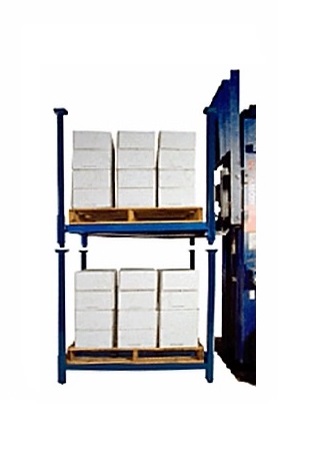
They are fully stackable, allowing multiple racks to be stacked one on top of another when loaded or nested together when empty, which helps save floor space.
The racks are built with sturdy steel side rails, welded frames or bolt-on beams (depending on model), and optional decking or tie-off points, which let you tailor each rack to your load size and handling needs.
What are window, door & millwork stack racks used for?
These racks are specially engineered to store, transport, and protect long, fragile, or bulky items such as windows, doors, millwork, and similar building components. Popular with window and door manufacturers, stocking distributors, dealers and retailers. They help prevent damage such as cracking, bending, or warping, which can happen when windows and doors are laid flat or stacked loosely.
Because they are portable and stackable, these racks allow you to transport materials from the warehouse to the jobsite, or move them around within a facility, with much less risk and handling.
What options and custom features are available?
Stack racks can be configured with a variety of enhancements, including:
Whether used as portable racks, shipping racks, tire racks, window, door & millwork racks or carpet/pad racks, these custom options help improve handling efficiency, product protection, and trailer cube utilization.
What types of materials can be stored in portable stack racks?
Portable stack racks are ideal for both palletized goods and hard-to-store bulky items. They are widely used for tires, windows, doors and millwork, carpet and pad rolls, bulk materials, super sacks, finished goods, boxes, pallet loads, and shipping applications where stability and protection matter. The 60″ x 60″ stack rack (PN 606060SR-WMD) is one of the most popular tire-storage racks in the industry. Optional wire decking, fork stirrups, and custom bases allow racks to be engineered for virtually any load type.
How do portable stack racks help improve warehouse space and efficiency?
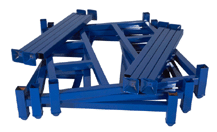
Stack racks maximize both vertical and horizontal space by allowing racks to be safely stacked up to five levels high. They increase bin capacity by up to 66%, reclaiming floor space that would be wasted with bulk stacking. When empty, they can be knocked down, nested, or disassembled, freeing up space for staging, shipping, or seasonal inventory changes. They are especially good in facilities that value layout flexibility and high-density storage.
What standard sizes and capacities are available?
We offer 12 standard stack rack sizes that we strive to keep in stock (subject to prior sale). Sizes range from 48″ x 48″ x 69″H all the way up to 48″ x 120″ x 69″H, with inside usable heights of 60″. Capacities range from 2,500–3,000 lbs. (UDL), depending on the model. All racks are stackable 4 high. Popular models include:
Many models include wire mesh decking and optional fork stirrups for safe lifting. Custom sizes and designs can also be manufactured.
What are portable stack racks and why are they so popular?
Portable stack racks are modular, heavy-duty steel storage racks designed to safely store, ship, and stack palletized or loose materials. They are widely used because they increase storage density, reduce product damage caused by bulk stacking, and offer far more flexibility than fixed pallet rack systems. Stack racks can be set up anywhere, moved with a forklift, and knocked down when not in use. This makes them one of the most versatile and space-saving rack solutions on the market.